
The 5 Best Debate, Model UN & Law Programs for High Schoolers (2026)
On this page
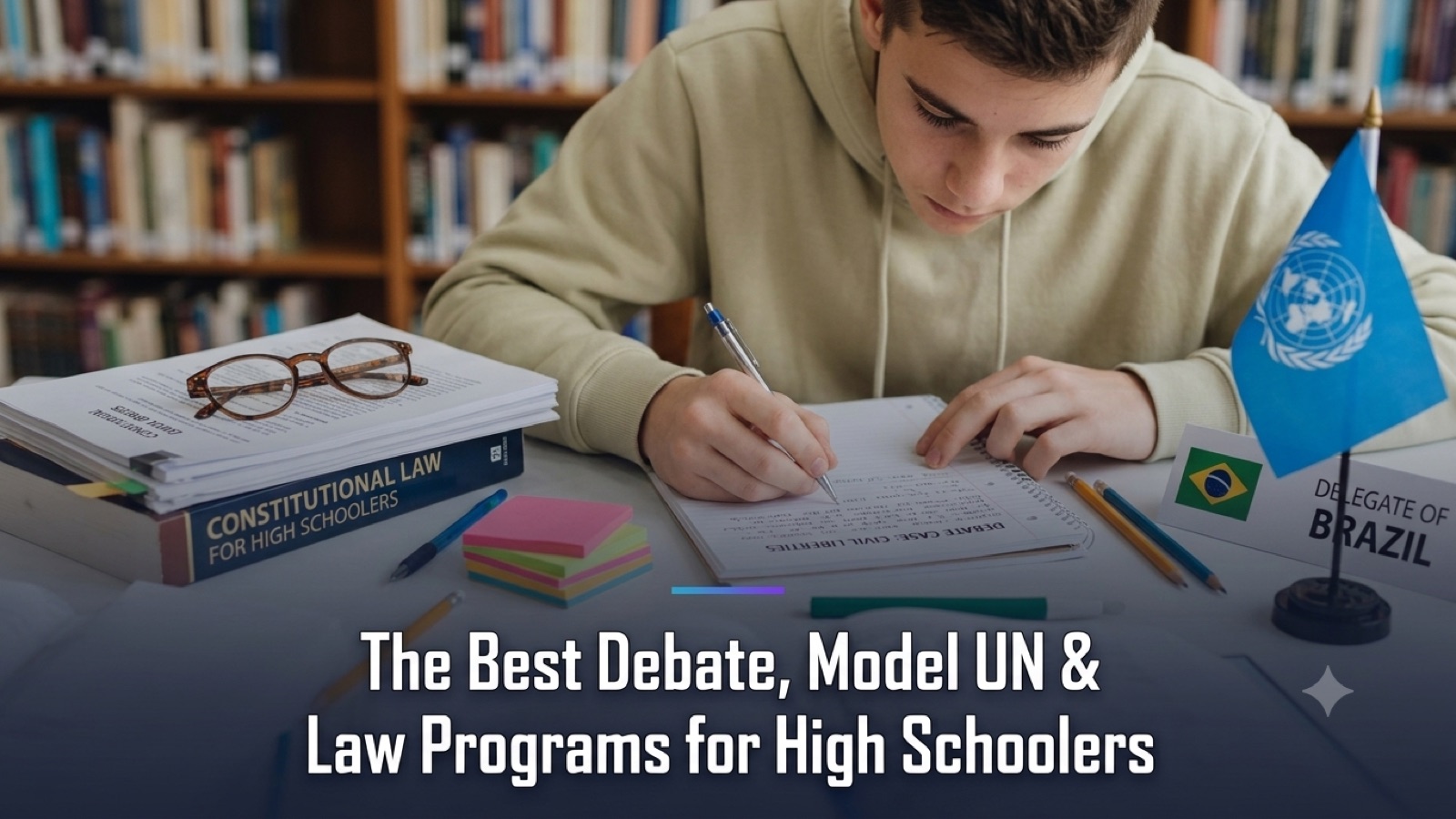
If you want a high schooler to argue clearly, research quickly, and speak on their feet, the fastest path is a team-based program: speech and debate through the NSDA, Model UN, mock trial, We the People, or a Boys/Girls State delegation. Almost all of them run through your school or a local chapter, most are US-based, and the skills they build carry straight into college and beyond.
Here are the 5 best debate, Model UN and law programs for high schoolers, what each is, who qualifies, and how to approach them.
1. National Speech & Debate Association (NSDA)
Type: School-team competition (districts and national tournaments) · Best for: Structured argument and speaking under pressure · Eligibility: US-based; join through a school debate/forensics team
The National Speech & Debate Association (NSDA) is the largest such organization in the United States and the backbone of competitive high school debate. Students compete through school teams that belong to local districts, earn points and recognition over time, and can qualify up through district tournaments toward the national championship.
The NSDA umbrella covers several distinct events, and most students specialize in one or two:
- Lincoln-Douglas — a one-on-one values debate focused on ethics and philosophy.
- Policy debate — two-person teams argue a year-long resolution with heavy evidence and research.
- Public Forum — team debate on current events, designed to be understood by a general audience.
- Congressional Debate — students play legislators, writing and debating bills in a mock chamber.
- Speech events — including original oratory, extemporaneous speaking, and interpretation events that reward writing and delivery more than clash.
What it develops: structured argument, evidence handling, rebuttal under time pressure, and the confidence to speak to a room. Extemporaneous and public-forum formats in particular build the ability to research a topic fast and explain it plainly.
How a beginner joins: ask whether your school has a debate or forensics team, and if so, which coach runs it. If your school does not have one, a nearby school's team, a community league, or a summer debate institute can be an entry point. Start with a beginner-friendly event like Public Forum or Congress rather than the most evidence-heavy formats.
2. Model UN (HMUN & NAIMUN)
Type: Committee simulation and conferences · Best for: Research, negotiation, and diplomatic writing · Eligibility: Worldwide; join through a school MUN club and advisor
Model United Nations (Model UN or MUN) is a simulation where students represent an assigned country on a committee and debate a real-world issue — security, climate, human rights, development — using the rules and procedures of the actual UN. Delegates research their country's position, write and negotiate resolutions, form voting blocs, and try to steer the committee toward an outcome.
Two of the most prominent high school conferences are:
- Harvard Model United Nations (HMUN), one of the oldest and largest MUN conferences, run by Harvard undergraduates and drawing delegations from around the world.
- The North American Invitational Model United Nations (NAIMUN), hosted by Georgetown University, another large and long-running conference on the high school circuit.
Schools typically send a delegation, so participation usually runs through a Model UN club and its faculty advisor. Some independent delegations and camps exist as well.
What it develops: research on unfamiliar topics, persuasive writing (resolutions and position papers), negotiation, and the diplomacy of building consensus with people who start out disagreeing with you. It rewards preparation and listening as much as speaking.
How a beginner joins: look for a Model UN club at your school. If there isn't one, a small group and a willing advisor can start a chapter and attend regional conferences before aiming at the flagship ones.
3. We the People: The Citizen and the Constitution
Type: Class-based constitutional hearing · Best for: Deep constitutional knowledge and arguing on the spot · Eligibility: US-based; a participating class at your school
We the People: The Citizen and the Constitution is a national civic-education program in which a class studies constitutional principles and then presents its knowledge in a simulated congressional hearing, defending positions before a panel of judges and answering follow-up questions. It runs as a classroom program and builds deep knowledge of the Constitution alongside the ability to argue and respond on the spot.
4. National High School Mock Trial Championship
Type: Team courtroom simulation · Best for: Cross-examination, quick thinking, and persuasion · Eligibility: US-based; school team, state qualifiers
The National High School Mock Trial Championship is the capstone of high school mock trial. Teams prepare and argue both sides of a fictional legal case, taking on the roles of attorneys and witnesses, following courtroom rules of evidence and procedure. State organizations run qualifying competitions, and state champions advance to the national event. Mock trial builds cross-examination skill, quick thinking, and a feel for how evidence and storytelling combine to persuade.
5. Boys State and Girls State
Type: Week-long government simulation · Best for: Leadership, civic understanding, and public speaking · Eligibility: US-based; school nomination through a local American Legion post
American Legion Boys State and Auxiliary Girls State are week-long summer programs where selected students build a model government from the ground up — running for office, passing legislation, and holding elections. They are sponsored by the American Legion and the American Legion Auxiliary and organized state by state, usually with students nominated through their schools. A small number of participants are selected for the national Boys Nation and Girls Nation programs. These develop leadership, civic understanding, and public speaking in a fast, immersive week.
What these programs share
Most of these programs are US-based and chapter- or team-based — you join through a school team, a club, or a local sponsoring organization such as a YMCA chapter or an American Legion post rather than signing up as an individual. That structure is a feature: you get coaching, teammates, and a competition calendar built in.
Here is a quick comparison of the core options.
| Program | Format | How you join |
|---|---|---|
| NSDA speech & debate | School team, district and national tournaments | School debate/forensics team |
| Model UN (HMUN, NAIMUN) | Committee simulation, conferences | School MUN club and advisor |
| We the People | Class-based constitutional hearing | Participating class at your school |
| Mock Trial (national championship) | Team courtroom simulation | School team, state qualifiers |
| Boys/Girls State | Week-long government simulation | School nomination, local Legion post |
Why colleges value them
Admissions officers read these activities as evidence of skills that are hard to fake: sustained commitment to a demanding activity, the ability to research and reason, and comfort speaking and writing under pressure. Leadership roles — team captain, club president, committee chair, an elected office at Boys or Girls State — signal initiative. And the through-line across all of them, from a debate rebuttal to a mock-trial closing to a Model UN resolution, is the same core competency: building an argument and delivering it convincingly.
These programs also feed directly into the rest of an application. The close reading and structured argument you practice show up in stronger essays and clearer interviews.
Where IvyStrides fits
The close reading, argument, and writing that debate builds are the same skills the SAT Reading and Writing section and the college essay reward. IvyStrides' SAT prep sharpens the reading-and-reasoning side, and our essay coaching helps students turn those debate and Model UN experiences into a focused personal statement. If you want to map out where a student stands, start with a free consultation.
For the full, verified list of debate, policy, and law competitions, see our academic competitions guide, or browse all academic competitions.
Frequently asked questions
Which program is best for a complete beginner? Speech and debate through a school team is the most accessible starting point, and within it, Public Forum or Congressional Debate tend to be friendlier for newcomers than the most evidence-heavy formats. Model UN is also beginner-friendly if your school has a club.
Do I have to attend a big-name conference like Harvard MUN to benefit? No. Regional and local conferences and tournaments build the same skills. Flagship events like HMUN and NAIMUN are worth aiming for over time, but most students start with smaller competitions close to home.
What if my school does not have a team or club? You can often join a nearby school's league, start a chapter with a faculty advisor and a few classmates, or go through a local organization — a YMCA chapter for some civic programs, or an American Legion post for Boys and Girls State nominations.
Are these programs only in the United States? Most of the ones covered here are US-based and organized state by state or through US school associations. Model UN is the notable exception, with conferences and delegations worldwide.
How much do these help with college applications? They demonstrate research, communication, and leadership, and they give students concrete experiences to write about. Consistent involvement and a leadership role matter more than a single event.

Hemant is a seasoned entrepreneur, investor, and growth strategist with deep ground in education and technology-driven learning. His core training is in Mathematics and Physics — he authored Physics for IB Diploma: Ultimate Revision Guide, recognized as a top student resource.