
The 8 Best Business & Economics Competitions for High Schoolers (2026)
On this page
- 1. DECA
- 2. FBLA (Future Business Leaders of America)
- 3. The National Economics Challenge
- 4. The Diamond Challenge
- 5. The Blue Ocean Competition
- 6. The Wharton Global High School Investment Competition
- 7. Wharton's Leadership in the Business World (LBW)
- 8. LaunchX
- How the options compare
- Free versus paid, and how to start
- Where academics fit in
- Frequently asked questions
If you want a high school activity that signals real interest in business or economics, the strongest options fall into three buckets: chapter-based organizations like DECA and FBLA, open pitch competitions like the Diamond Challenge and Blue Ocean, and selective summer programs like Wharton's Leadership in the Business World and LaunchX. Start with whichever one you can actually enter this year, and let results compound from there.
Here are the 8 best business and economics competitions for high schoolers, what each one is, who qualifies, and how to approach them.
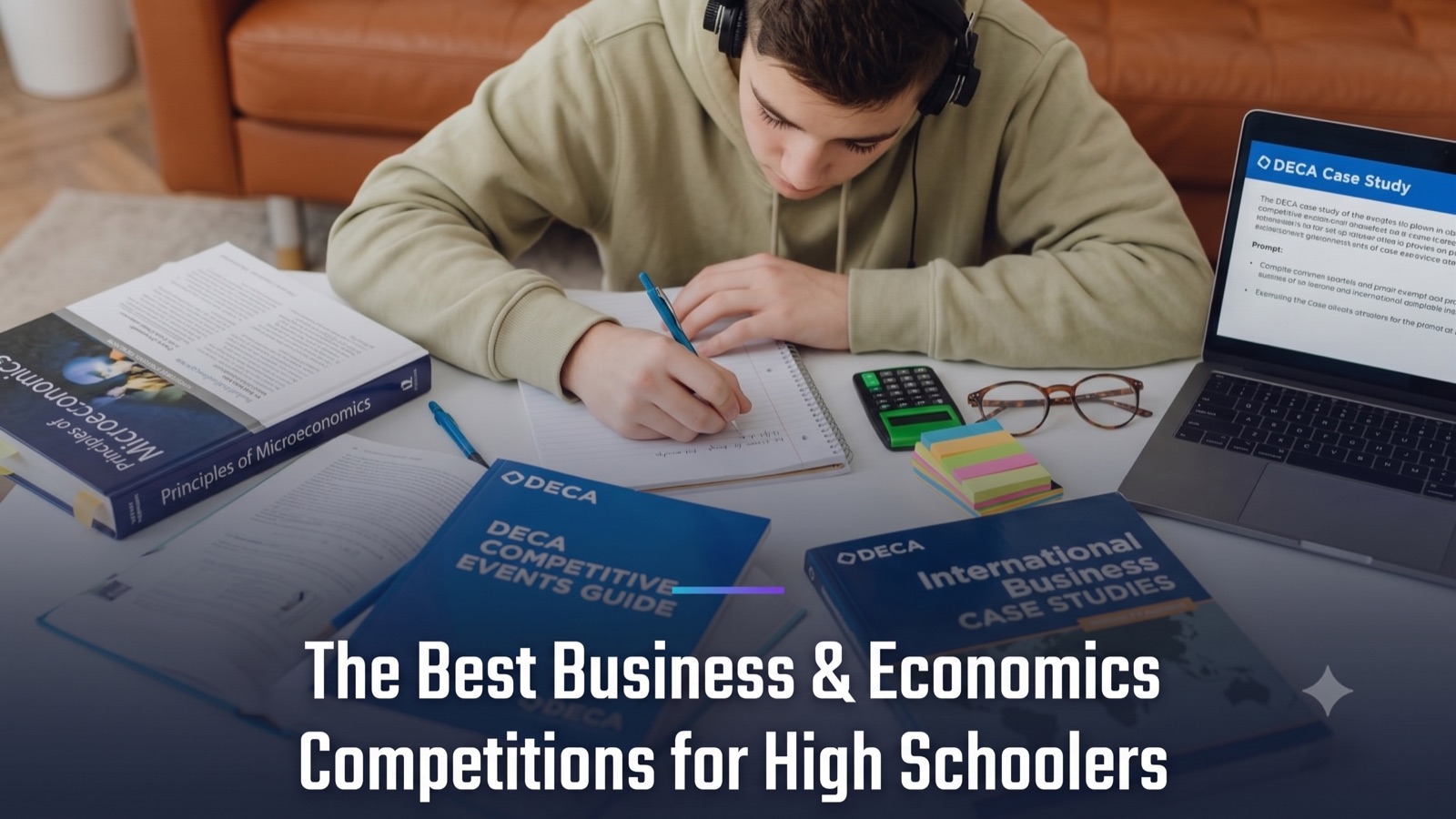
1. DECA
Type: Chapter-based organization · Best for: Case-style problem solving and presenting under pressure · Eligibility: Join through your school's chapter
DECA focuses on marketing, finance, hospitality, and entrepreneurship. Its competitive events combine an exam with a role-play or written project, so you're tested on both business knowledge and how you present under pressure. DECA is a good fit if you like case-style problem solving and thinking on your feet. It runs through your school — you join a chapter (often tied to a business or economics teacher who serves as adviser), then compete at regional, state, and national levels. If your school doesn't have a chapter, a teacher can usually start one. It's worth joining early: advancing from regionals to state to nationals takes more than one attempt for most students, so freshman or sophomore year is a good time to start.
2. FBLA (Future Business Leaders of America)
Type: Chapter-based organization · Best for: Broad exposure across business events · Eligibility: Join through your school's chapter
FBLA covers a broad slate of business events — accounting, business communication, economics, entrepreneurship, marketing, and more. Some events are objective tests; others are presentations or team projects. The breadth makes FBLA easy to enter regardless of which corner of business interests you. Like DECA, it advances from regionals to state to nationals, so starting freshman or sophomore year gives you the room to progress.
3. The National Economics Challenge
Type: Team competition · Best for: Analytical economics reasoning · Eligibility: U.S. high schoolers, in divisions by coursework
The National Economics Challenge, run by the Council for Economic Education, is the flagship economics competition for U.S. high schoolers. Teams answer questions across microeconomics, macroeconomics, and current events, competing in divisions that account for how much economics coursework you've done. It rewards genuine economic reasoning, not memorized definitions, so it pairs well with an AP Economics course or independent study. If you're drawn to the analytical side of the field rather than starting a company, this is a natural target. Prepping with a small team and a teacher-coach is the usual path.
4. The Diamond Challenge
Type: Open pitch competition · Best for: First-time founders · Eligibility: Enter directly — no school chapter needed
The Diamond Challenge, hosted by the University of Delaware's Horn Entrepreneurship, invites students to submit either a business or a social-innovation concept and advances finalists through rounds of evaluation. It's structured, well established, and welcoming to first-time founders. Like other open pitch competitions, you don't need a school chapter to enter — you form a small team (or compete solo, depending on the rules), develop a business idea, and submit a pitch, which makes it one of the fastest ways to get started.
5. The Blue Ocean Competition
Type: Open pitch competition · Best for: Getting started fast · Eligibility: Submit a video pitch
The Blue Ocean Competition is an entrepreneurship pitch competition built around submitting a video pitch, which lowers the barrier to entry — there's no in-person round required to participate initially. Because it's open, you enter directly rather than through a chapter, which makes it an easy on-ramp if your school has no business organizations.
6. The Wharton Global High School Investment Competition
Type: Open competition · Best for: Finance and disciplined decision-making · Eligibility: Form a team
The Wharton Global High School Investment Competition is different in flavor: teams act as investment advisers, build a strategy for a hypothetical client, and manage a simulated portfolio. It emphasizes finance and disciplined decision-making rather than launching a product. A useful feature of many pitch and open competitions is broad eligibility — several are open to students worldwide, not just those in the United States, so international students often qualify. Always confirm the current rules on the official site before you build a team around any assumption.
7. Wharton's Leadership in the Business World (LBW)
Type: Selective summer program · Best for: Immersive, on-campus business fundamentals · Eligibility: Application-based
Wharton's Leadership in the Business World (LBW) brings admitted students to the University of Pennsylvania for an intensive introduction to business fundamentals, leadership, and team projects. It's selective and academically serious. If you want an immersive, on-campus experience rather than a competition, this is one of the two main summer tracks — applications-based, often paid, and more competitive to get into than joining a chapter.
8. LaunchX
Type: Selective summer program · Best for: Learning entrepreneurship by building · Eligibility: Application-based
LaunchX takes an entrepreneurship-first approach: students form teams and work to build an actual startup over the program, moving from idea to a functioning venture with mentorship along the way. If your goal is to learn by building, this leans practical rather than lecture-based. Because these selective summer programs are competitive and often carry a cost, plan applications early and check for financial aid where it's offered.
How the options compare
| Program | Type | How you enter |
|---|---|---|
| DECA | Chapter-based org | Join your school's chapter |
| FBLA (business events) | Chapter-based org | Join your school's chapter |
| National Economics Challenge | Team competition | Team + teacher-coach |
| Diamond Challenge | Open pitch competition | Enter directly |
| Blue Ocean Competition | Open pitch competition | Submit a video pitch |
| Wharton Global HS Investment Competition | Open competition | Form a team |
| Wharton LBW | Selective summer program | Apply |
| LaunchX | Selective summer program | Apply |
Free versus paid, and how to start
Costs vary widely. Chapter organizations usually involve membership dues plus travel to state and national events. Pitch competitions range from free to modest entry fees, and some offer prize funding. Summer programs like LBW and LaunchX are the most expensive, though aid may be available. Read the fine print before committing.
The simplest way to start is to pick one entry point and act on it this term:
- If your school has a DECA or FBLA chapter, join it. If it doesn't, ask a business or economics teacher about starting one.
- If you want to move immediately and independently, enter an open pitch competition like the Diamond Challenge or Blue Ocean.
- If economics is your interest, build a small team for the National Economics Challenge alongside AP Economics.
- If you want an immersive experience, note the application deadlines for summer programs well ahead of time.
For a fuller, verified list with current details, see our roundup at /academic-competitions/#business-economics, part of our broader guide to academic competitions.
Where academics fit in
Business and economics tracks reward strong quantitative and verbal skills — the same skills that show up in your test scores and coursework. A solid foundation in math and reading helps with everything from investment simulations to writing a persuasive pitch. IvyStrides' SAT prep and AP courses are built to develop that foundation, and you can talk through a plan on a free consultation.
Frequently asked questions
Do I need a school chapter to compete? Not always. DECA, FBLA, and similar organizations are chapter-based, so you join through your school. Pitch competitions like the Diamond Challenge and Blue Ocean are open — you enter directly without any chapter.
Can international students participate? Many pitch competitions are open to students worldwide, and some accept video submissions from anywhere. Eligibility rules differ by program and can change year to year, so always verify on the official website before forming a team.
Which one should a beginner start with? If your school has a DECA or FBLA chapter, that's the easiest on-ramp. If not, an open pitch competition lets you start right away without waiting for a chapter to exist.
Are these competitions free? It depends. Chapter organizations charge dues and travel costs, pitch competitions range from free to small fees, and selective summer programs are the most expensive — though some offer financial aid.
Do business competitions help with college admissions? They demonstrate sustained interest and initiative, especially when you advance over time or build something real. Pair them with strong grades and test scores rather than treating them as a substitute for academics.

Rajesh is a technology leader, entrepreneur, and angel investor with 28+ years in Business & Technology Leadership and Product & Solution Engineering. He is passionate about education, mentoring, and driving digital transformation.