
Is Notre Dame University the Right Fit for You? A Comprehensive Guide

On this page
- What Makes the University of Notre Dame a Compelling Option?
- Academic Rigor, Without Pretension
- Not Just a Campus. A Community That Moves With Intent
- For the Right Student, It Doesn’t Just Fit. It Clicks.
- Are You Competitive Enough? Understanding Notre Dame’s Admissions Landscape
- GPA & Academic Performance: More Than Just Numbers
- Test Scores: Optional, Not Irrelevant
- Restrictive Early Action (REA): A Quiet Advantage
- What Makes a Notre Dame Application Stand Out?
- How to Apply to the University of Notre Dame - Step by Step
- 1. Choose Your Application Track
- 2. Apply Through the Common App
- 3. Complete the Notre Dame Writing Supplement
- 4. Decide Whether to Submit Test Scores
- 5. International Applicants: Read the Fine Print
- 6. Submit Financial Aid Documents
- 7. Final Review Before You Hit Submit
- What’s the Return on Investment at Notre Dame University? Career, Cost & Long-Term Value
- Career Preparation That Starts Early and Scales Well
- Salaries That Reflect the Education (and the Network)
- Cost of Attendance, and What Families Actually Pay
- Should You Apply to the University of Notre Dame or Not? Take The Test
- Ready to Apply or Still Deciding? We’re Here to Help.
- Here’s what we offer:
- FAQs About Applying to Notre Dame
There’s something about Notre Dame University that resists quick categorization. It doesn’t court you with glossy promises or viral TikToks. It doesn’t have to. The gold dome glints in quiet defiance of trends, and the school’s reputation, which is equal parts grit, gospel, and gravitas, echoes well beyond its Midwestern coordinates.
And yet, if you’re reading this in a quiet suburb outside Dallas or flipping through college options between AP classes in Austin, chances are you’re not just asking if Notre Dame is impressive. That’s settled. You’re wondering if it’s a place where you’d belong, thrive, and eventually launch from. That’s a very different question.
At IvyStrides, we’ve worked with students who see Notre Dame as a dream and others who see it as a riddle. What they share is not blind ambition but honest curiosity: Is this school worth my time, my score, my story? Because applying to a college like Notre Dame is never just about grades. It’s about fit, philosophy, and future.
This piece won’t hard-sell you. We’re not recruiters. We're educators. Our job is to help you ask sharper questions and notice what the brochures never mention. If you're looking for clarity about Notre Dame’s culture, its academic rigor, its ROI, and its soul, you’re in the right place.
Let’s begin where all good decisions do: with the truth.
What Makes the University of Notre Dame a Compelling Option?
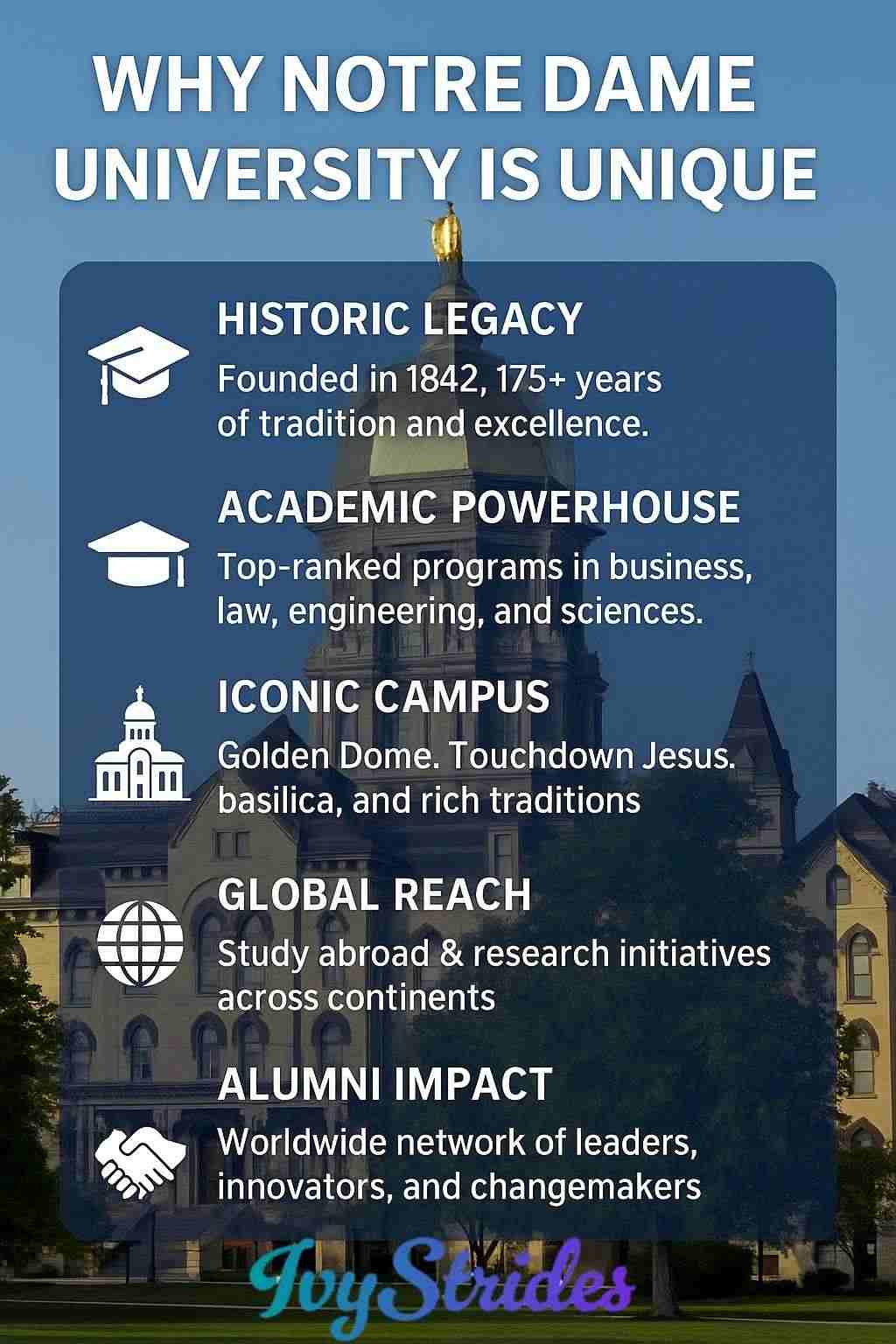
Notre Dame doesn’t shout for attention. For nearly two centuries, it has quietly cultivated a reputation for excellence that doesn’t lean on trend, celebrity, or coastal polish. Notre Dame University is set just outside South Bend, Indiana, with its campus unfolding something between a monastery and a research village. The place has a pulse. You feel it most near the Basilica, or late at night at the Grotto, where the quiet isn’t silence, it’s respect.
Academic Rigor, Without Pretension
At the academic core are schools that don’t need to explain themselves.
- The Mendoza College of Business routinely ranks among the top undergraduate business programs in the country.
- The College of Engineering is powerful in the mechanical and civil tracks.
- The College of Science draws serious pre-med students.
- The Keough School of Global Affairs, a newer but globally minded addition, attracts those with an eye on diplomacy, human rights, and development.
- And then there’s the College of Arts and Letters—a home for philosophers, writers, historians, and economists looking for a unique lens to explore the world.
Research isn’t reserved for graduate students; centers like the IDEA Center (Innovation, De-Risking, and Enterprise Acceleration) and the Center for Social Concerns create space for undergraduates to build, fail, rework, and launch.
Not Just a Campus. A Community That Moves With Intent
You won’t find sprawling anonymity here. The university’s residential system keeps students in the same hall for most of their undergrad years. From Walsh, Keenan, Lewis, to Sorin, Dillon, and Farley, each dorm has its own culture, events, and even rivalry.
Friday evenings often lead students to the DeBartolo Performing Arts Center or a quiet table at Rohr’s inside the Morris Inn. Game days are another story altogether; Notre Dame Stadium wakes the entire town. But during the week, the mood is more focused, almost monastic.
For the Right Student, It Doesn’t Just Fit. It Clicks.
The students who choose it tend to be intentional, not in a performative, résumé-stacking way, but in how they move through the world. If you’re looking for a college experience that’s tightly knit, ethically grounded, and academically real, Notre Dame belongs on your shortlist.
Are You Competitive Enough? Understanding Notre Dame’s Admissions Landscape
Notre Dame isn’t interested in perfection, but rather in preparation, and while admission is competitive, it’s not inaccessible. Last cycle, Notre Dame admitted just under 13% of applicants. That’s not Ivy-level impossible, but it’s selective enough to require strategy. Let’s break down what they’re looking for, and what they’re not saying outright.
GPA & Academic Performance: More Than Just Numbers
Most admitted students fall within the top 5–10% of their high school class. A GPA above 3.9 (unweighted) is common, but not sacred. Admissions officers are reading transcripts for course rigor: AP, IB, dual enrollment, and whether you challenged yourself where it counted.
Test Scores: Optional, Not Irrelevant
Yes, Notre Dame is test-optional, for now. But if your SAT or ACT score is in range, it still works in your favor.
- Middle 50% SAT: 1420–1550
- Middle 50% ACT: 32–35
If you fall above the median, submit. If you’re below the GPA threshold but your course rigor and other elements are intense, consider leaning on different parts of your application, especially the supplemental essay.
Restrictive Early Action (REA): A Quiet Advantage
Notre Dame’s Restrictive Early Action program isn’t binding, but it does limit where else you can apply early. You won’t be able to apply Early Decision elsewhere, which means this option is best for students who view Notre Dame as a top choice.
Last year, the REA admit rate hovered near 20%, significantly higher than the Regular Decision pool. But don’t be misled: those numbers reflect stronger applicants who knew they were ready early.
Apply REA if:
- You’ve completed intense junior-year coursework.
- Your test scores (if submitted) are competitive.
- You’ve spent time on the supplemental responses.
- Notre Dame is genuinely at or near the top of your list.
What Makes a Notre Dame Application Stand Out?
Notre Dame is not a school that’s impressed by volume. Ten clubs won’t matter if none reflect substance. A 4.0 won’t raise eyebrows if it’s paired with bland writing.
Standout applicants often share a few traits:
- Precise alignment with Notre Dame’s mission and values.
- Demonstrated initiative or leadership (school, community, research, work).
- Writing that feels personal, focused, and grounded, especially in the “Why Notre Dame” supplement.
The takeaway? You don’t have to be perfect, just prepared.
How to Apply to the University of Notre Dame - Step by Step
The application process of Notre Dame is straightforward, but the expectations are high, and unspoken details can make the difference between a solid application and a memorable one. Here’s how to approach it, step by step.
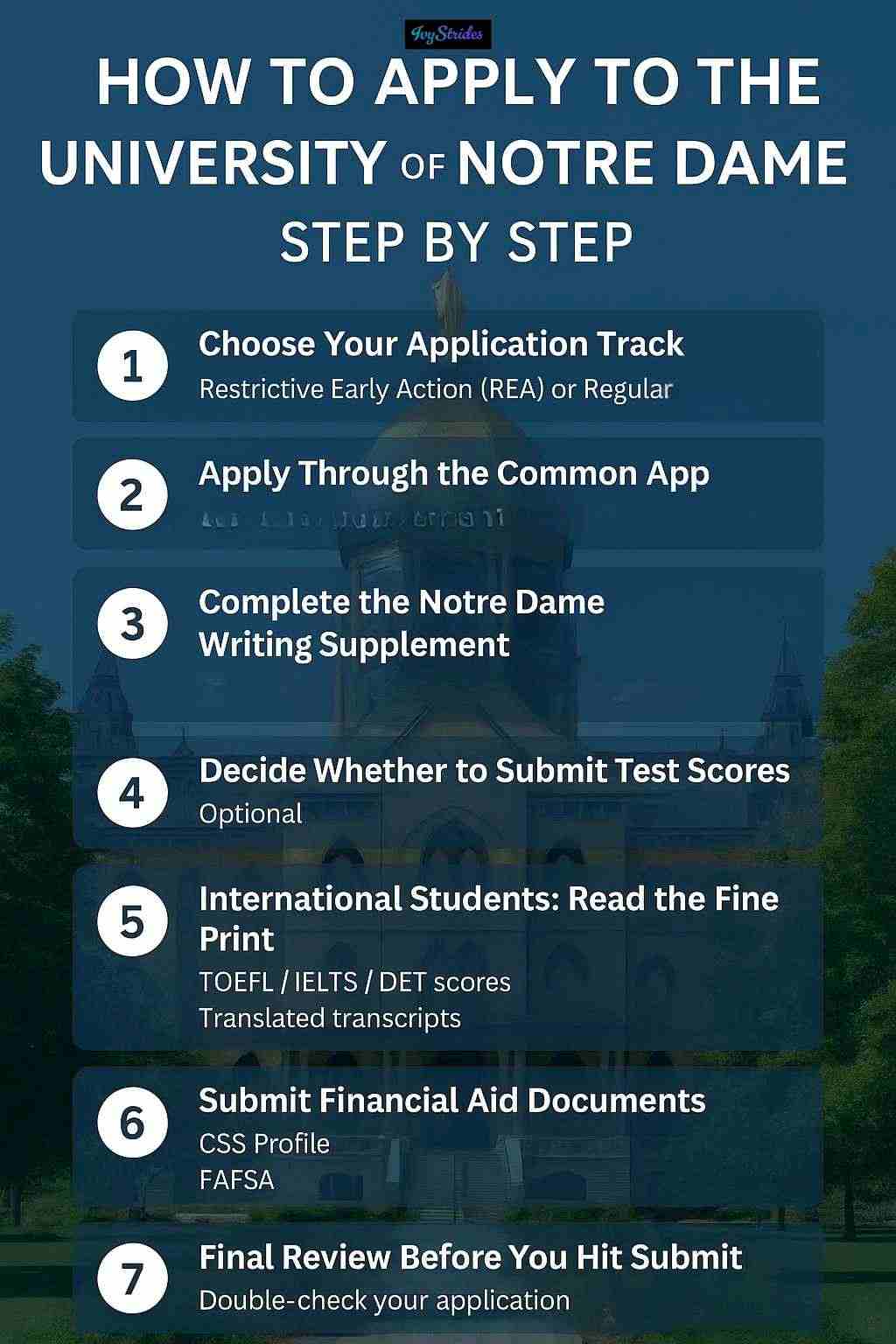
1. Choose Your Application Track
Notre Dame offers two options:
- Restrictive Early Action (REA) - Non-binding, due November 1
- Regular Decision - Due January 1
If you’re ready early and you’re serious about Notre Dame, REA may give you a strategic edge. Just remember: no Early Decision applications elsewhere.
2. Apply Through the Common App
Notre Dame doesn’t use the Coalition App. You’ll submit everything through the Common Application, including:
- Your transcript
- School profile and counselor recommendation
- Two academic teacher recommendations
- Activities list
- Personal essay (standard Common App prompt)
3. Complete the Notre Dame Writing Supplement
This part carries weight. You’ll be asked to respond to two short-answer prompts (typically around 200 words each), chosen from a list. These questions are designed to reveal how you think, what you care about, and whether you understand the Notre Dame ethos.
Don’t try to be impressive. Be sharp, specific, and sincere.
4. Decide Whether to Submit Test Scores
Notre Dame is test-optional. But optional doesn’t mean irrelevant.
Submit scores if:
- You’re within or above the median range (SAT 1450+, ACT 33+).
- Your GPA doesn’t fully reflect your academic strengths.
- You’re applying from a school or region where Notre Dame sees fewer applicants.
Don’t submit if:
- Your scores fall well below the middle 50%.
- Your application is already strong in rigor, writing, and extracurriculars.
- You need to re-test and can’t meet the deadline.
5. International Applicants: Read the Fine Print
If you're applying from outside the U.S., you'll also need:
- TOEFL, IELTS, or DET scores (unless you’re from an English-medium school).
- Official translated transcripts.
- A financial certification form (for visa documentation).
Notre Dame values international perspectives, but the standards are consistent. They want students who can succeed in a highly verbal, discussion-based classroom environment.
6. Submit Financial Aid Documents
- CSS Profile (for institutional aid).
- FAFSA (for federal assistance).
- Due mid-November for REA applicants, mid-February for RD.
Notre Dame meets 100% of demonstrated financial need, but doesn’t offer merit aid in the traditional sense. That means your academic stats alone won’t unlock scholarships, but your financial context may unlock substantial support.
7. Final Review Before You Hit Submit
Before you apply, double-check:
- Your recommender relationships are solid.
- Your essays feel personal and specific.
- You’ve shown why you’re a strong fit for this school.
What’s the Return on Investment at Notre Dame University? Career, Cost & Long-Term Value
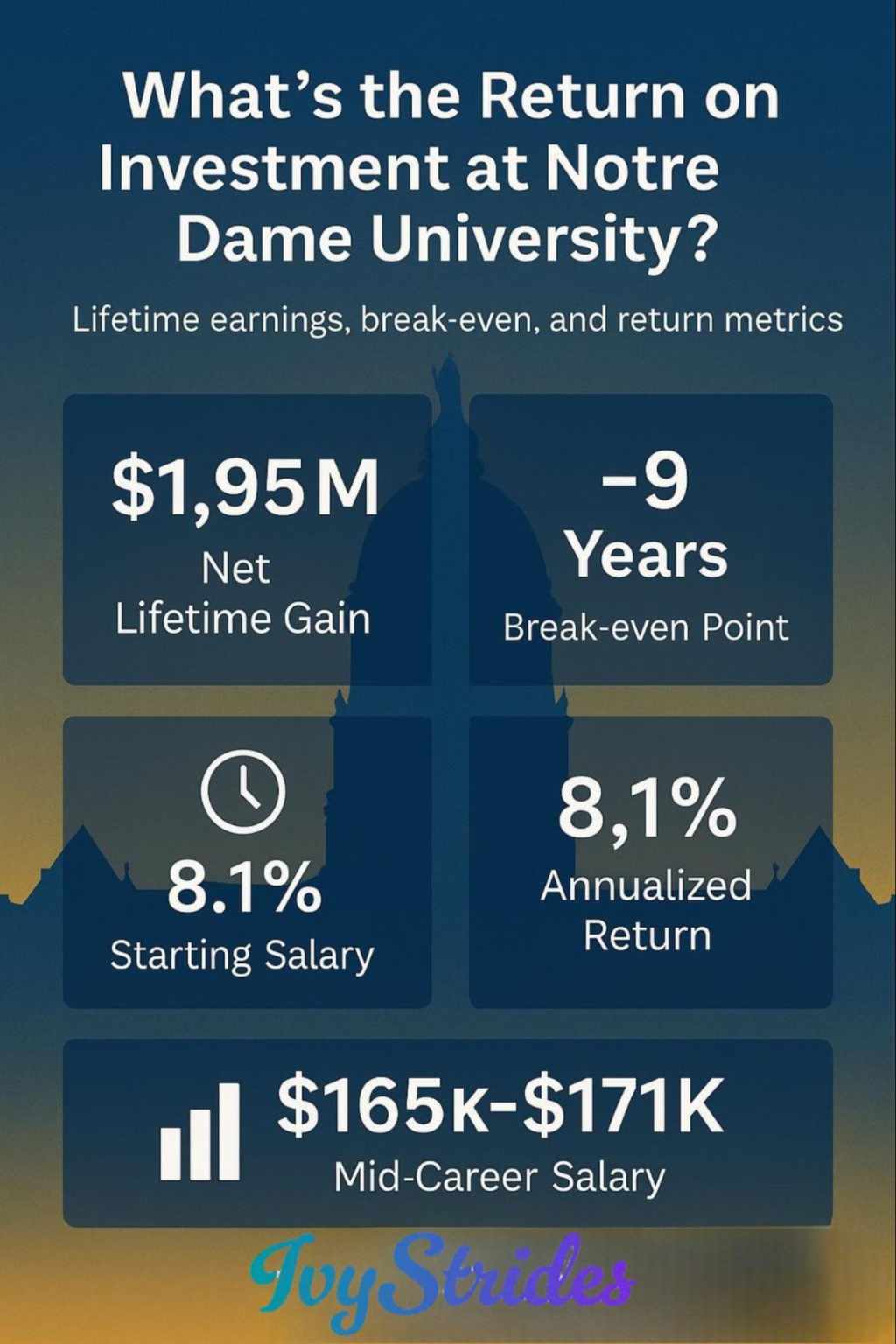
Notre Dame has always leaned on outcomes rather than advertising. So let’s talk outcomes, some measurable ones.
Career Preparation That Starts Early and Scales Well
You won’t have to hunt for internships on your own. Notre Dame’s Center for Career Development begins working with students from their first year, including resume reviews, mock interviews, on-campus recruiting, alum networking, and employer treks.
The companies that show up to recruit at Notre Dame don’t need an introduction. Think JPMorgan Chase, McKinsey, Apple, Deloitte, Google, and Johnson & Johnson.
Placement rates consistently top 95% within six months of graduation.
Salaries That Reflect the Education (and the Network)
Notre Dame graduates don’t just find jobs. They find well-paying ones.
- Average starting salary (Class of 2023): $77,000
- Engineering majors: $80K+
- Business (Mendoza): $76K
- Arts & Letters: $60K–$70K, with strong grad school admissions
Alum connection matters here. Notre Dame’s network is a strong and active one. Regional alum clubs across Texas and the U.S. regularly mentor, refer, and hire new grads.
Cost of Attendance, and What Families Actually Pay
Sticker price for 2026–2027 is expected to cross $85,000 per year (tuition, housing, books, fees included). But don’t let that number speak for itself.
Notre Dame commits to meeting 100% of demonstrated financial need for every admitted student. That means no student is denied based on what they can afford. Aid is primarily need-based; the university doesn’t offer traditional merit scholarships, but it does support low- and middle-income families extensively.
Families making under $75K often pay little to no tuition. Those between $100K–$150K can still receive significant need-based support, depending on assets and sibling status.
Schedulea Consultation Call with IvyStridesExpert and learn how to make elite education affordable.
Should You Apply to the University of Notre Dame or Not? Take The Test
This isn’t a quiz with a correct answer. No algorithm can tell you whether four years in South Bend will shape you the way you hope.
You should apply if:
- You’re academically prepared, and you’ve challenged yourself honestly.
- You value purpose over prestige, but wouldn’t mind both.
- You’re drawn to structure, not just in academics, but in how a place holds itself.
- You’d thrive in a campus that speaks in tradition, but moves with intent.
- You can see yourself lighting a candle at the Grotto just because it feels right, even if you’re still figuring out what you believe.
You might hold off if:
- You want total academic flexibility without core requirements.
- You’re seeking a louder social culture or a looser campus identity.
- You prefer a school that reshapes itself every five years to match what’s trending online.
If Notre Dame aligns with your story, apply boldly; if it doesn’t, keep looking. The right college doesn’t just admit you. It calls you in.
Here at IvyStrides, we never push students into colleges that only look impressive. We help them find schools that match who they are and who they’re becoming.
Ready to Apply or Still Deciding? We’re Here to Help.
You don’t have to figure it out alone. At IvyStrides, we’ve helped students across Texas and beyond get into schools like Notre Dame, not just by polishing applications, but by asking the right questions early. If you’re still unsure whether you should apply, or if you already know and want to make your profile stand out, we’re ready when you are.
Here’s what we offer:
- Personalized SAT prep designed for competitive schools.
- 1:1 admissions planning for Notre Dame and other top-tier universities.
- Honest feedback from real educators, no fluff, no false promises.
FAQs About Applying to Notre Dame
Does it matter what major you choose when you apply?
Yes, a little. You apply to the university first, but some programs, like Business and Engineering, have limited seats. Choosing one won’t hurt you, but you should show interest and readiness for that field.
Can you change your major or college after getting in?
Yes. You can switch majors. Moving between colleges (like from Arts & Letters to Mendoza) is possible but needs approval. Some require a second application.
Does Notre Dame offer interviews?
No, not for admissions. Sometimes alums may reach out, but it’s optional and won’t affect your application.
How do students get into Notre Dame’s top scholar programs?
Programs like Hesburgh-Yusko and Stamps are by invitation only. You can’t apply. Admissions chooses students who show leadership, service, and strong academics.
Can students study abroad?
Yes. About 3 out of 4 students do. Programs are in places like Rome, Dublin, and Tokyo. Financial aid usually carries over.
What support is there for first-generation students?
Notre Dame helps first-gen and low-income students with money, mentors, and events. The Office of Student Enrichment is your leading resource.
Still have questions?Contact us

Hemant is a seasoned entrepreneur, investor, and growth strategist with deep ground in education and technology-driven learning. His core training is in Mathematics and Physics — he authored Physics for IB Diploma: Ultimate Revision Guide, recognized as a top student resource.