
Should You Apply to Johns Hopkins University? A Complete Strategy for Admission, Essays, and SAT Success
On this page
- Is Johns Hopkins the Right Fit for You - Academically, Globally, and Personally?
- Academic Culture: Intense, Independent, and Built for the Inquisitive
- Who Excel Here? (Hint: It’s More Than Just a 1500+ SAT)
- Global Roots, Local Impact: A Truly International Community
- The Vibe Check: Are These Your People?
- Career Outcomes That Walk the Talk
- What It Really Takes to Apply and Get Accepted to Johns Hopkins Today
- Your First Decision: When to Apply
- Application Platforms
- Academic Eligibility - What They Expect
- Do You Have to Declare a Major?
- Application Fee and Waivers
- What Johns Hopkins Really Wants From Your Essays - And How to Deliver It
- Essay Expectations
- How to Make Your Hopkins Essay Stand Out
- Need Help Finding Your Story?
- Cracking the SAT for Johns Hopkins - The IvyStrides Approach to Strategy, Superscoring & Smart Prep
- What is a Johns Hopkins acceptable SAT score?
- How IvyStrides Makes a Difference
- Is Johns Hopkins Affordable?
- Going Global: Important Information for Foreign Students Applying to JHU
- International Students' Application Requirements
- Dreaming Beyond Borders? Let's Build Your Global Application
- Conclusion: Should You Submit an Application to Johns Hopkins University?
- FAQs - What Students & Parents Are Really Asking
Tucked into the academic fabric of the East Coast,Johns Hopkins University isn’t just a college, but a launchpad for the intensely curious. Founded in 1876, Johns Hopkins University (JHU) was America’s first research university, and it's been rewriting the rules of academic excellence ever since.
Johns Hopkins is where lab coats meet global policy, where a senior thesis might double as published research, and where students whisper about Nobel Prizes the way others talk about football scores.
If you’re a student, you might be asking:
“Is Hopkins my kind of place? Is it worth the pressure, the prep, the precision?”
Smart question.
Because Johns Hopkins University is not a casual pick, it's academically relentless, profoundly research-driven, and built for students who’d rather analyze the DNA of a crisis than just scroll past the headlines.
And yet it’s also surprisingly human, collaborative, international in spirit, local in mentorship, grounded in Baltimore’s historic charm, but globally connected like no other.
In this guide, we’ll help you decide with clarity whether Hopkins belongs on your college list, what SAT scores give you a shot, how the admissions process really works, and how to craft essays that sound like you.
Whether you’re aiming to disrupt biotech, reimagine public health, or simply stand out in the admissions pile, IvyStrides will help you build a data-driven, deeply personal strategy that works.
Let’s begin.
Is Johns Hopkins the Right Fit for You - Academically, Globally, and Personally?
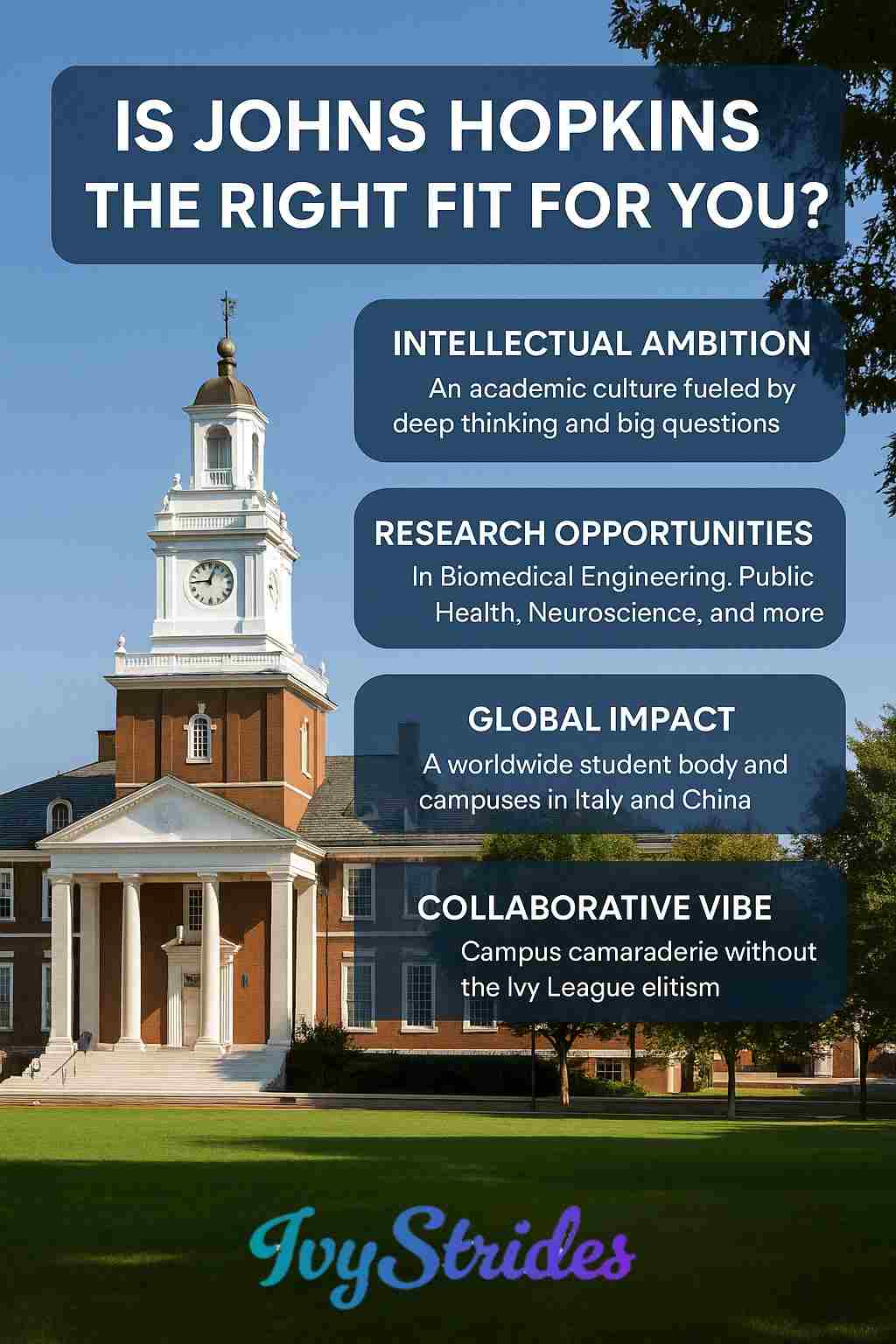
Johns Hopkins University is a testing ground for those who are insatiably curious, let's face it. For those who enjoy reading science journals, writing poetry while taking mathematics, or watching films on public health on the weekends, Hopkins may feel more like a calling than a reach.
Academic Culture: Intense, Independent, and Built for the Inquisitive
Set in Baltimore, Maryland, the Homewood campus blends East Coast charm with research-fueled ambition. Think ivy-clad red-brick buildings, sunlit quads, and some of the country’s most advanced labs, all just a train ride from D.C., Philly, and NYC. From the iconicGilman Hallto the buzz ofBrody Learning Commons, it’s a place where ideas and caffeine flow freely. There's even an observatory, a sculpture garden, and underground library stacks that feel like something out of a novel.
JHU is home to powerhouse programs like Biomedical Engineering, public health from the Bloomberg School of Public Health, and Neuroscience from the Zanvyl Krieger School of Arts and Sciences. You’ll hear classmates casually reference their internship at NIH or their AI project modeling protein folding.
Who Excel Here? (Hint: It’s More Than Just a 1500+ SAT)
Yes, Hopkins focuses on more than just grades. Consider a SAT score of 1500+ and a demanding AP/IB curriculum. Data-savvy storytellers, slam-poet doctors, and violin-playing chemists flourish at Johns Hopkins.
If you're a self-starter, determined individual who enjoys intricacy, this place will feel like home base.
Global Roots, Local Impact: A Truly International Community
JHU is designed for global thinkers, with campuses in China, Italy, and Washington, D.C., and students from more than 120 nations. Local perspectives are still heard, though, and whether you're from Plano, Texas, or Pune, India, you'll discover a college dedicated to cultural sensitivity and practical results.
Among the best student affairs ecosystems in the country, it balances diversity efforts, leadership programs for a globally conscious generation, and mental health resources.
The Vibe Check: Are These Your People?
Hopkins students are curious, creative, and quietly intense, not just chasing GPAs but looking for meaning in what they study. It’s not a rah-rah football culture. It’s more TEDx meets biomechanics lab, or late-night debates on bioethics over coffee at Brody Café.
While the coursework is elite, the community isn’t elitist. There’s mutual respect for hustle, no matter what form it takes.
Career Outcomes That Walk the Talk
From Michael Bloomberg and Dr. Ben Carson to Nobel-winning researchers and Pulitzer Prize journalists, JHU grads don’t just land great jobs; they shape entire fields.
At IvyStrides, we offer SAT prep programs explicitly designed for driven students eyeing elite universities like Johns Hopkins.
What It Really Takes to Apply and Get Accepted to Johns Hopkins Today
So, what does it actually take to land a spot at Johns Hopkins?
With acceptance rates of only about 6%, Hopkins is a very selective university where every aspect of your application counts. However, that does not imply that it is a mystery. You can apply with clarity and confidence if you know what they look for (and what they don't).
Your First Decision: When to Apply
Johns Hopkins offers three central admissions rounds:
- November 1st is Early Decision I (ED I).
- January 2 is Early Decision II (ED II).
- January 2 is the regular decision (RD).
ED applicants get a statistically stronger edge, but only apply early if JHU is your top choice and your profile is ready.
Application Platforms
You can apply using:
- The Common Application
- The Coalition Application (via Scoir)
Both work equally well, just make sure you meet deadlines and gather all documents early.
Academic Eligibility - What They Expect
Hopkins isn’t prescriptive with GPAs, but most admitted students rank in the top 5% of their class. Your course load should show rigor: APs, IBs, honors, and consistency across subjects.
Ideal applicant profiles include:
- Strong math and science foundation (especially for BME, Pre-med, or Public Health).
- Evidence of intellectual curiosity beyond the classroom.
- Leadership or initiative, not necessarily as president of a club, but as someone who starts things, solves things, and builds things.
JHU doesn’t require subject tests, but top AP/IB scores can help distinguish your profile.
Do You Have to Declare a Major?
Nope. Hopkins has an open curriculum, meaning you don’t apply to a specific major. That said, your interests should still make sense across your activities, essays, and optional "why major" sections.
For example:
- A student listing “Neuroscience” as an interest might show summer research or volunteer hours in related fields.
- A “Public Health” applicant might reference health equity projects or related advocacy.
Application Fee and Waivers
- The application fee is $70
- Fee waivers are available via the Common App or a school counselor recommendation.
- International students can also request waivers based on financial circumstances.
Want help deciding between ED I, ED II, and Regular Decision?
Our free application strategy session at IvyStrides helps students choose the right path and the right timing based on score bands, GPA trends, and essay readiness.
What Johns Hopkins Really Wants From Your Essays - And How to Deliver It
Your essays will open the door if the SAT gives you a leg up. The essay is where you may finally express yourself in a sea of flawless scores and 4.0 GPAs.
Essay Expectations
You’ll submit:
- One Common App personal statement
- One supplemental essay unique to JHU
That second one is where they lean in.
Past prompts include:
"Describe a thought-provoking project, idea, or intellectual experience that you found exciting."
"Tell us about a time you worked with others to accomplish a shared objective or solve a problem."
They’re not after your résumé in prose form. They're reading for how you think, what excites you, and whether you can reflect on an experience beyond surface-level takeaways.
How to Make Your Hopkins Essay Stand Out
The most successful essays we’ve seen share these ingredients:
- A specific moment or story, and not a sweeping life history.
- A fresh angle with something that doesn’t show up anywhere else in your app.
- Depth is not just what you did, but why it mattered to you.
- Clear, confident writing, conversational, but intentional.
Avoid the clichés:
- “I’ve always wanted to help people…”
- “This one summer camp changed everything…”
- “My biggest weakness is that I care too much…”
If it sounds like it could be on a thousand other apps, it probably is.
Need Help Finding Your Story?
At IvyStrides, we work one-on-one with students to help them build an essay that allows them to pave their way to the future. Our common app essay coaching program helps students shape authentic stories that stand out in the most competitive pools, especially at places like Hopkins.
Cracking the SAT for Johns Hopkins - The IvyStrides Approach to Strategy, Superscoring & Smart Prep
When you’re aiming for a school like Johns Hopkins, your SAT score isn’t just a number; it’s a signal. A 1530 tells admissions you don’t just test well, you prepare with intention. And that’s precisely what JHU expects: intention, strategy, and intellectual firepower.
What is a Johns Hopkins acceptable SAT score?
You should aim for a goal score between 1500 and 1560 with exceptional section scores if you want to be a competitive applicant. Despite JHU's declared test-optional policy, most accepted students nevertheless take and perform well on their SATs. When applying to demanding programs like International Studies, Engineering, or Neuroscience, having high test results can help you win.
Superscoring: Your Unknown Tool
Because Johns Hopkins superscores the SAT, your best section scores from all test dates are taken into account. In other words, you are sending a 1540 if you received a 760 in math in August and a 780 in reading in October.
Your SAT Prep Timeline
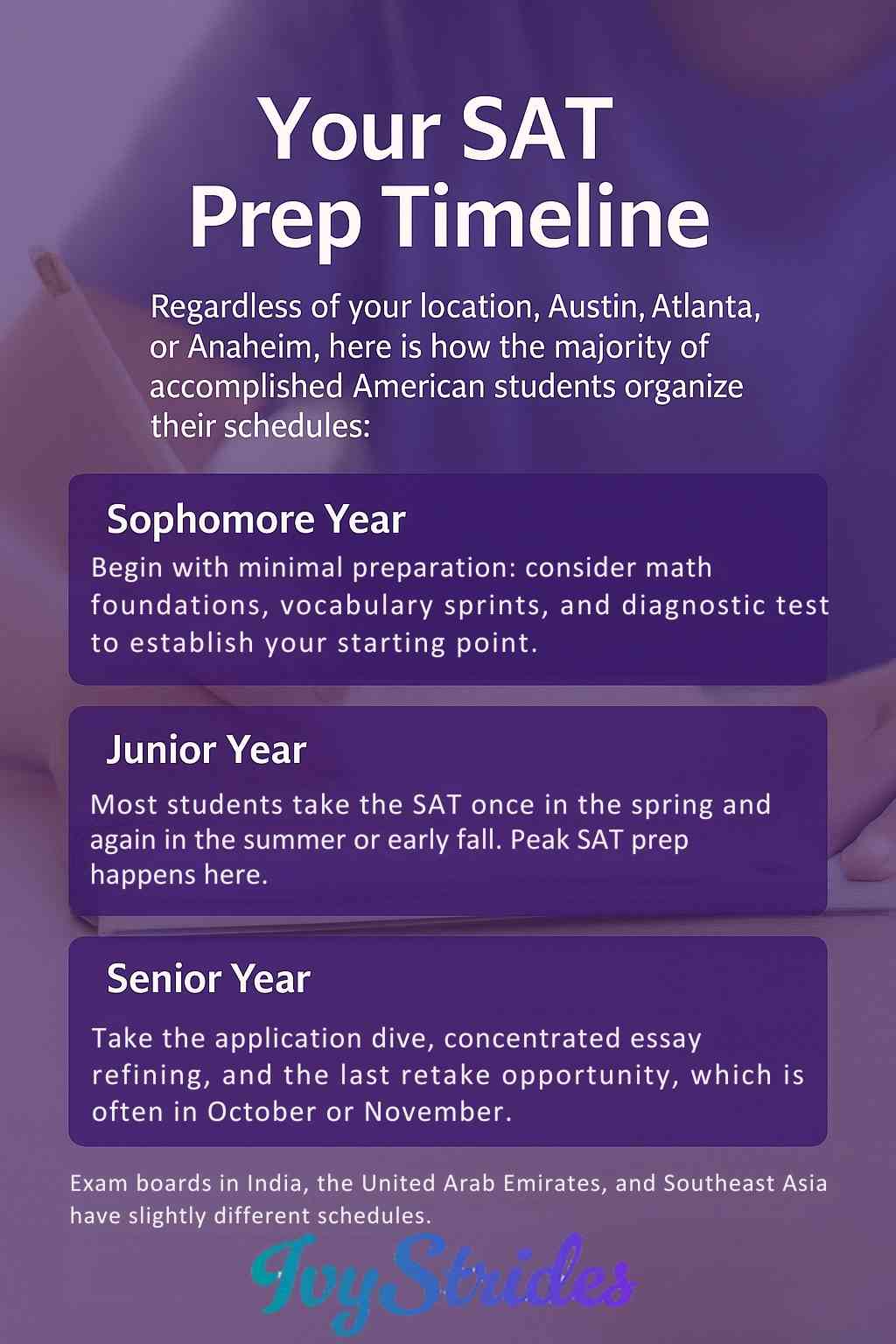
Regardless of your location, Austin, Atlanta, or Anaheim, here is how the majority of accomplished American students organize their schedules:
Sophomore Year
Begin with minimal preparation, consider math foundations, vocabulary sprints, and a diagnostic test to establish your starting point.
Junior Year
Most students take the SAT once in the spring and again in the summer or early fall. Peak prep happens here.
Senior Year
Take the Application drive, concentrated essay refining, and the last retake opportunity, which is often in October or November.
Exam boards in India, the United Arab Emirates, and Southeast Asia have slightly different schedules. The idea is still the same, though: get started early, make innovative refinements, and strive for superscore accuracy.
How IvyStrides Makes a Difference
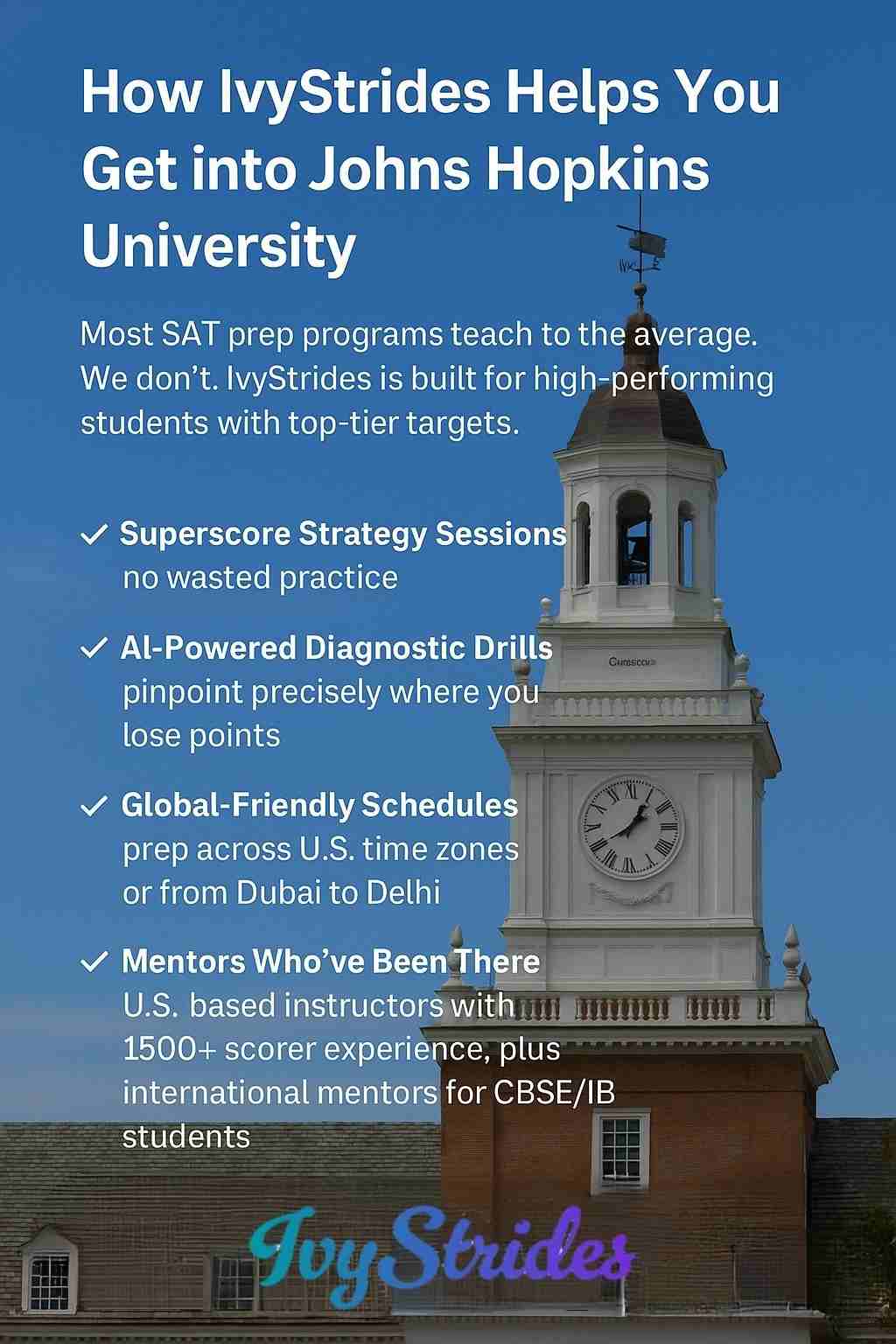
Most SAT prep programs teach to the average. We don’t. IvyStrides is built for high-performing students with top-tier targets.
Here’s how we prep smarter:
- Superscore Strategy Sessions: no wasted practice.
- AI-Powered Diagnostic Drills - pinpoint precisely where you lose points.
- Global-Friendly Schedules - prep across U.S. time zones or from Dubai to Delhi.
- Mentors Who’ve Been There - U.S.-based instructors with 1500+ scorer experience, plus international mentors for CBSE/IB students
Ready to Aim Higher Than 1500 and build your SAT strategy for schools like Johns Hopkins? Consult with our elite SAT tutors: U.S.-based and globally trained.
Is Johns Hopkins Affordable?
Let’s talk numbers. Because while Johns Hopkins may look like a wallet-buster, it’s a lot more accessible than most families think if you know how to approach the system.
Financial Aid: What’s Real (and What’s Not)
First, the good news: Hopkins is need-blind for U.S. applicants. That means your ability to pay won’t hurt your chances of getting in. For families earning under $125,000, tuition is fully covered. And if your household earns under $65,000, JHU may cover everything: housing, meals, books, and more.
Now the nuance: while aid is generous for U.S. students, international financial assistance is limited and highly competitive. But it's still possible, especially if you bring a standout SAT score, academic track record, and a compelling story.
Planning - FAFSA, CSS Profile & Scholarship Strategy
Hopkins uses theCSS Profile in addition to theFAFSA, and deadlines matter. Missing a date could mean missing tens of thousands in aid. Many students also supplement their aid packages with private scholarships, research assistantships, or on-campus jobs.
From understanding the complexities of the FAFSA to creating scholarship-ready profiles, we at IvyStrides help families, both domestically and abroad, with every financial step.
We are available to assist you at every stage, whether you are completing your first CSS Profile or looking into aid as an international applicant.
Going Global: Important Information for Foreign Students Applying to JHU
Not only is Johns Hopkins a major university in the United States, but it also draws motivated students from all over the world. If you have international academic aspirations, JHU could be the springboard you need, regardless of where you are, Hong Kong, Hyderabad, or Houston.
International Students' Application Requirements
If you're applying from outside the U.S., here's what you’ll need on your checklist:
- To prove English proficiency, take theTOEFLor IELTS.
- Official transcripts with available translations.
- SAT or ACT scores are optional but strongly advised if you want to pursue competitive majors or merit aid.
- Recommendation letters, preferably from instructors who are aware of your preferred method of learning.
- Proof of financial support for the student visa process.
Deadlines follow U.S. patterns: Early Decision I (Nov 1), ED II (Jan 2), and Regular Decision (Jan 2), so get those documents in order early.
I-20, Visa Assistance, and the SEVIS Procedure
To help students receive their I-20 papers, get ready for interviews for F-1 visas, and complete SEVIS registration, all of which are necessary for studying in the United States, Hopkins maintains a specialized international services staff. They are effective, knowledgeable, and sincere in their desire to ensure that pupils feel encouraged right away.
Dreaming Beyond Borders? Let's Build Your Global Application
From selecting the proper standardized tests to acing your visa process, our mentors at IvyStrides specialize in helping international students turn ambition into acceptance.
Meet an IvyStrides Global Admissions Mentor
Conclusion: Should You Submit an Application to Johns Hopkins University?
You've now seen everything: the competition, the culture, the essays, and the stats. So, ought one apply?
Suppose you’re intellectually curious, hungry for academic challenge, and excited by real-world research. Yes, if that describes you, you should give Johns Hopkins a try. It is for the self-driven, not the passive or the indecisive. Whether you're a sophomore beginning SAT preparation or a senior editing your essay, keep in mind that while you need to be prepared, you don't have to be perfect.
That’s where IvyStrides steps in. Because they have a plan, not simply hope, our students have succeeded at prestigious universities.
IvyStrides is here to make the process strategic rather than stressful, regardless of where you are in the process of writing your Common App.
Book Your Free 1-on-1 Consultation at IvyStrides now!
FAQs - What Students & Parents Are Really Asking
If I'm unsure of my major, can I still apply?
Indeed! For students who aren't sure, Hopkins is an excellent option. Before deciding on a course of study, you can take classes in a variety of areas.
Will I get an interview when I apply?
Maybe. Interviews are optional and usually done by alums. If offered, they’re a nice way to add a personal touch to your application.
Do I need lots of extracurriculars?
No. What matters more is what you care about and what you’ve done with it. A few high-quality activities are preferable to a lengthy list of unfocused ones.
As a student, what sort of help can I expect?
Hopkins assists in a variety of ways, including career preparation, mental health support, and research mentors and advisors. You’re never on your own.
Can I transfer from another college to Johns Hopkins?
Yes, but it's difficult. Good college grades, compelling transfer arguments, and program space are requirements. Most transfer spots open for the fall.

Hemant is a seasoned entrepreneur, investor, and growth strategist with deep ground in education and technology-driven learning. His core training is in Mathematics and Physics — he authored Physics for IB Diploma: Ultimate Revision Guide, recognized as a top student resource.