
Should You Apply to Dartmouth College? 2026 Admission Trends You Must Know
On this page
- What Makes Dartmouth Different - And Is It the Right Fit for You?
- Is it possible to get into Dartmouth College in 2026? Admissions Trends and What They’re Looking For
- Does Making a Decision Early or Regularly Matter?
- What Qualifies as "Competitive"?
- The Dartmouth D-Plan: Flexibility That Opens Global Doors
- You can-
- The Dartmouth College Admissions Process: Step by Step
- Step 1: Pick Your Application Round
- Step 2: Gather What You Need
- Step 3: Work On Your Essays
- Step 4: Don’t Miss Financial Aid Deadlines
- Step 5: (Optional) Alumni Interview
- Step 6: Stay on Track
- Boosting Your SAT Strategy for Dartmouth: How IvyStrides Helps You Stand Out
- So what’s the game plan?
- Crafting Your ‘Why Dartmouth’ Essay: Show How You Belong
- How Dartmouth Stands Out Among Ivy League Colleges
- Is Dartmouth a Good Place to Apply? Here's How to Make a Confident Choice.
- Ready to Apply? Book Your Dartmouth Profile Review with IvyStrides
- FAQs
Most Ivy League conversations orbit around the usual suspects, the coast-hugging giants with postcard campuses and name-brand bravado. But just north of the noise, in a town edged by pines and ideas, stands a college that doesn’t market itself loudly because it doesn’t have to.
Dartmouth College isn’t just another Ivy. It’s the one that feels entirely its own.
Tucked in the heart of New Hampshire, it balances the intimacy of a liberal arts college with the horsepower of a world-class research institution. You’ll find students building satellites, skiing before class, debating climate policy with faculty, and graduating straight into roles at the UN, Google, or their own start-ups. It’s global, but grounded. Rigorous, but personal. Competitive, but uncommonly collaborative.
At IvyStrides, we’ve worked with ambitious students across Texas, California, Dubai, and Delhi, and we’ve noticed something: the ones who thrive at Dartmouth College aren’t chasing prestige. They’re looking for purpose, proximity, and professors who push them past easy answers.
Should you apply to Dartmouth in 2026? If you’re looking for more than rankings, and you’re curious about a place that quietly shapes global thinkers, this might be your Ivy.
Here’s what you should know.
What Makes Dartmouth Different - And Is It the Right Fit for You?
Yes, Dartmouth is the right fit if you’re drawn to intellectual intensity wrapped in community and not a crowd.
You’ll feel it by your second step onto theGreen:Dartmouth Collegedoesn’t perform prestige, it lives it differently. Whether it’s First-Year Trips in the White Mountains or late-night study sessions atCollis, the college blends the physical and intellectual seamlessly.
Tucked in Hanover, New Hampshire, Dartmouth offers the intimacy of a liberal arts college, complete with theHood Museum of Art, wrapped in the research muscle of the Ivy League. You’ll see Nobel laureates teaching undergrads and first-year students pitching startups over coffee at Novack. The experience is rigorous, but never impersonal.
The campus itself feels curated, not crowded. Baker-Berry Libraryis more of a cathedral of focus than a building.The Hopkins Centersurprises you, one night it’s a jazz trio, the next, a Pulitzer-winning poet in residence. Just beyond the books sit canoe clubs, ski trails, and research labs that don’t wait for grad school to welcome you in.
Dartmouth’s House Communities aren’t dorms, they’re ecosystems of collaboration. You won’t just pass classmates in hallways; you’ll challenge, celebrate, and create with them. And thanks to the D-Plan, Dartmouth’s quarter-based calendar, your education bends with your ambition: internships in Singapore, language study in Rabat, research in Chile, all while staying on track.
But what truly sets Dartmouth apart? The global power of its alumni and their willingness to pull the next person up. Dr. Seuss, Mindy Kaling, Robert Frost, Shonda Rhimes, Daniel Webster, Jake Tapper, Dartmouth grads sit in the West Wing, shape policy at the UN, launch biotech startups, and produce Emmy-winning television.
It’s not a school that suits everyone. But if you’re looking for a college that’s fiercely focused, unexpectedly global, and deeply human, Dartmouth might just feel like yours.
At IvyStrides, we’ve seen Dartmouth click best for students who are collaborative, curious, and crave flexibility without sacrificing academic depth. If you want rigor without pretension, global reach with personal mentorship, and a college that still feels like a college, not a brand, then yes, Dartmouth might be the right fit.
Is it possible to get into Dartmouth College in 2026? Admissions Trends and What They’re Looking For
Dartmouth may be tucked into the pines of New Hampshire, but when it comes to admissions, it sees applications from nearly every ZIP code and continent. And with a 2026 acceptance rate hovering around 6%, the competition is real but not impenetrable.
Here’s the nuance most students miss: Dartmouth isn’t just admitting students with top GPAs and SAT scores. They’re looking for what we at IvyStrides call “quiet intensity” students with intellectual spark, global awareness, and an authentic sense of purpose. They have favored candidates in recent cycles who combine a strong track record with initiative, grit, and an engaging personal story.
Does Making a Decision Early or Regularly Matter?
It can, really. Since Early Decision fills nearly half of Dartmouth's class, applying early could provide you with a significant advantage if you know it's your preferred choice and your academic profile falls within (or near) that range. However, ED cannot compensate for subpar work; your essays, suggestions, and grades must still be strong.
How does your SAT score compare? Check out our guide onSAT score ranges and trends for top-tier colleges.
What Qualifies as "Competitive"?
- SAT range: 1470–1560 (middle 50%)
- ACT range: 32–35
- GPA: Most successful applicants are near the top of their class
- Essays & Recommendations: Highly weighted in holistic review
- Activities: Depth > breadth. Leadership or sustained impact is key.
- Context: Admissions takes your school, background, and opportunities into account.
And for international students, we’ve seen strong results when SATs are paired with excellent TOEFL/IELTS scores and evidence of English proficiency in essays and interviews.
Don’t forget to plan early! Refer to our SAT dates 2026 breakdown to align your prep with deadlines.
The Dartmouth D-Plan: Flexibility That Opens Global Doors
Dartmouth doesn’t just follow a quarter system. It redefines what academic pacing can look like. The D-Plan, as it’s famously called, gives students something rare in the Ivy League: absolute, structural freedom.
Instead of locking into a traditional semester schedule, Dartmouth students choose four 10-week terms per year, with the ability to be on or off campus during any term after their first year. What does that mean in practice?
You can-
- Spend a winter term interning in D.C. while your classmates study abroad in Berlin.
- Take your junior spring off to research in India, then return in the summer for a full course load.
- Stay year-round in Hanover, deepening connections with professors and research labs.
- Build a résumé that shows initiative, not just involvement.
This system doesn’t just benefit wanderlust; it caters to ambition. Dartmouth students often cite the D-Plan as the reason they were able to study abroad multiple times, pursue funded research, or accept that dream internship, even when other schools said, “not now.”
In our experience at IvyStrides, the D-Plan works best for self-starting students who don’t need a rigid structure to excel, and who value agency in shaping their college timeline. Align your application with theSAT Registrationto ensure your scores arrive before your chosen round.
The Dartmouth College Admissions Process: Step by Step
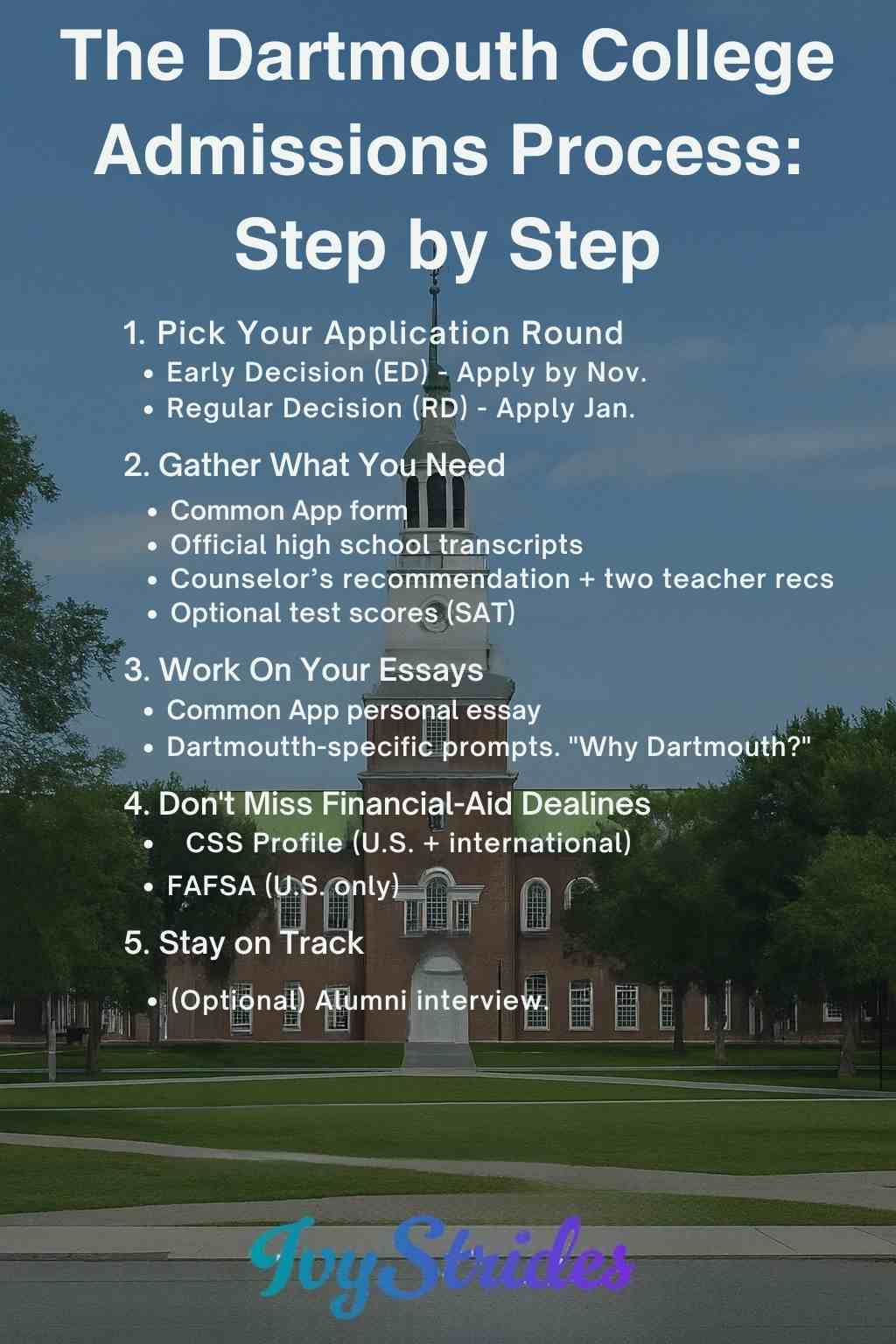
Applying to Dartmouth may seem like a big deal, and it is, but with the proper steps, it becomes less daunting. Let’s walk through the process clearly so you know what to expect and where to focus.
Step 1: Pick Your Application Round
Dartmouth offers:
- Early Decision (ED) - Apply by Nov 1. This step is binding and shows a strong interest.
- Regular Decision (RD) - Apply by Jan 3. More flexible, but more competitive.
Not sure which to choose? Our advisors at IvyStrides can help you decide what fits best.
Step 2: Gather What You Need
Here’s your checklist:
- Common App form
- Official high school transcripts
- Counselor recommendation + two teacher recs
- Optional test scores (SAT/ACT still help!)
Before you lock in your application, don’t miss thisSAT Test Checklist. It's a student-approved guide to make sure you’re fully ready.
Step 3: Work On Your Essays
This step includes:
- Common App personal essay
- Dartmouth-specific prompts, especially “Why Dartmouth?”
Want creative ideas? Check ourDream College Posters for inspiration that keeps you motivated during essay writing.
Step 4: Don’t Miss Financial Aid Deadlines
Dartmouth is need-aware for international students but meets 100% of demonstrated need for all admitted students.
You’ll need:
- CSS Profile (U.S. + international)
- FAFSA (U.S. only)
Check deadlines early, and try to file documents a week before official dates for peace of mind.
Step 5: (Optional) Alumni Interview
If invited, we suggest saying yes. It’s relaxed, conversational, and shows genuine interest. Come with a few questions to ask and speak from the heart.
Step 6: Stay on Track
Once submitted, you’ll get access to Dartmouth’s applicant portal to check materials, updates, and later decisions.
Want to get a better idea of your academic fit? Use our SAT Calculator to see if your scores align with Dartmouth’s average range.
Boosting Your SAT Strategy for Dartmouth: How IvyStrides Helps You Stand Out
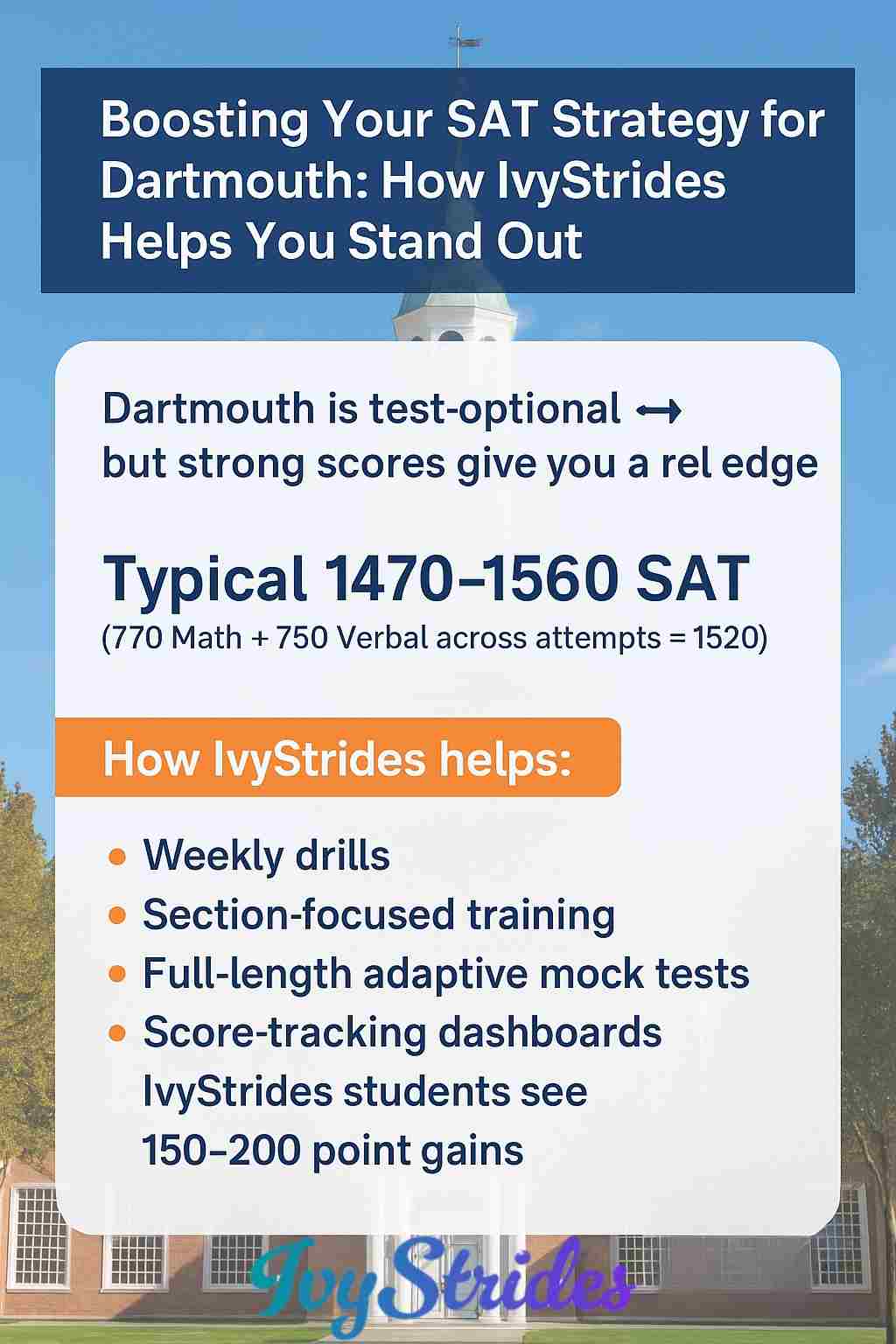
Make no mistake, even while Dartmouth is still test-optional, a high SAT score can still help you win. Strong scores indicate preparedness and can make up for other weaknesses in your profile, especially for applicants from competitive areas.
The majority of accepted students report SAT scores between 1470 and 1560. Additionally, Dartmouth superscores your best section scores over several exam dates (e.g., 770 Math + 750 Verbal = 1520). Strategic testing is essential, particularly if you want to gain an advantage.
So what’s the game plan?
At IvyStrides, we don’t hand you a generic prep schedule and wish you luck. We build custom SAT systems, especially for students targeting top-tier schools like Dartmouth. That means:
- Weekly drills focused on your weak zones
- Full-length digital mock tests that mirror the real exam
- A score dashboard to track your growth
- Test-day strategies that work even if you’re prone to nerves
Many of our students see 150–200 point improvements in just a few months, not because they study harder, but because they study smarter.
Want to know what a good SAT really looks like for 2026? Explore ourSAT Score Guide for benchmarks, superscore strategy, and percentile breakdowns.
International applicants should also build in TOEFL or IELTS prep if English isn’t their first language. We can help with that, too. You can find practice exams and prep on ourSAT Practice Test Portal. It's free to explore.
Crafting Your ‘Why Dartmouth’ Essay: Show How You Belong
The “Why Dartmouth?” essay can make or break your application. It’s not about listing dorms, quoting mission statements, or dropping professor names you found two hours before the deadline.
What Dartmouth wants to see is how your values and curiosity line up with theirs and how you’ll use the D-Plan, academic freedom, and community culture in ways only you could.
Here’s what works:
- Reflecting on what excites you about Dartmouth’s interdisciplinary approach.
- Mentioning how the D-Plan would support your internship goals or global ambitions.
- Connecting personal growth with campus offerings (outdoor programs, research centers, etc.).
Avoid the obvious. Don’t say “Dartmouth is prestigious” or “has a beautiful campus.” Instead, get specific. Are you drawn to its student-led sustainability work? Native American studies? Or its close-knit learning culture?
At IvyStrides, we guide students through the essay brainstorm process with a strategy that’s more personal than plug-and-play.
Join our Common App Essay Coaching program, which helps students move from blank page to standout story, and yes, we specialize in Dartmouth supplements.
How Dartmouth Stands Out Among Ivy League Colleges
Dartmouth isn’t trying to be the biggest Ivy. When it comes to the proper student, it's all about striving to be the boldest.
Dartmouth feels more intimate than bigger Ivies like Cornell or Columbia. You are more than a name on a list. Because of the 7:1 student-to-faculty ratio, instructors genuinely know you by name and push you to succeed.
Additionally, Dartmouth finds this unique middle ground: outdoorsy, focused, collaborative, and a little unconventional, whereas Harvard seems high-pressure and Brown leans ultra-liberal. It is attempting to be genuinely exceptional rather than to be polished.
What else gives Dartmouth an edge?
- Its quarter-based D-Plan lets you mix research, internships, and travel year-round.
- A tight alum network that actively opens doors from Wall Street to the UN.
- Good reputation as an employer: Graduates of Dartmouth attend prestigious medical and legal institutions, along with institutions like Google, McKinsey, and the White House.
You won't discover a true sense of community at every Ivy League school.
Therefore, while comparing fit and prestige, consider if you want the experience that comes with it or just the name.
So if you’re weighing prestige vs. fit, ask yourself: Do you want the name only or the experience that comes with it?
Is Dartmouth a Good Place to Apply? Here's How to Make a Confident Choice.
Understandably, applying to an Ivy League school is a significant decision. But clarity comes when you focus on fit, not just rankings.
The good news is that Dartmouth provides large aid packages for international students and is need-blind for U.S. candidates.
And our staff at IvyStrides is available to help make the process easier if you need support at any time, whether it's creating a school list or enhancing your profile.
Ready to Apply? Book Your Dartmouth Profile Review with IvyStrides
Do not leave your application up to chance if Dartmouth is on your radar. Our goal at IvyStrides is to assist students in improving their essays, polishing their profiles, and increasing their chances of getting into top universities like Dartmouth.
Our admissions specialists work one-on-one with students, whether they are in Texas or another country, to highlight their unique qualities.
To begin, consult one of our counselors. We'll help you make an informed decision on whether Dartmouth is the correct course of action.
FAQs
Are there any resources or programs specifically designed for first-generation college students at Dartmouth?
Indeed. Through initiatives including mentorship programs, specialized advising, and the FYSEP (First-Year Student Enrichment Program), Dartmouth provides robust support for first-generation students. It's one of the few Ivies that offers year-round, structured support that combines community development with academics.
At Dartmouth, is it possible to double major?
Of course. Students at Dartmouth are permitted to double major or create a modified major that creatively combines two fields (for example, Economics modified with Public Policy). This adaptability is a defining feature of Dartmouth's curriculum.
What kinds of internships are offered by Dartmouth University?
Because the D-Plan is available when other students aren't, Dartmouth students frequently land off-cycle internships at prestigious companies like Google, UNICEF, Goldman Sachs, and more.
Are students who would rather live in cities than in rural areas a good match at Dartmouth?
Hanover can seem more sedate if you're looking for an urban bustle, but many Dartmouth students claim that the close-knit, distraction-free atmosphere really aided in their success. Also, if you occasionally have a hankering for the city, Boston is just a short drive away.
Does Dartmouth assist students who want to start their own business?
Yes, students have access to startup incubators, mentorship, and seed money through the Magnuson Center for Entrepreneurship. Former founders frequently come back to mentor current pupils.

Hemant is a seasoned entrepreneur, investor, and growth strategist with deep ground in education and technology-driven learning. His core training is in Mathematics and Physics — he authored Physics for IB Diploma: Ultimate Revision Guide, recognized as a top student resource.