
Should You Apply to Brown University? How to Decide, Apply, and Get Accepted
On this page
- What Makes Brown University a Magnet for the Bold and Curious
- The Open Curriculum: Learn What Lights You Up
- On-Campus Icons That Shape the Brown Experience
- When Innovation Meets Architecture
- Is Brown the Right Fit for You? Ask Yourself These 7 Questions
- Brown Majors, Paths, and Possibilities: What Can You Study Here?
- Top Majors That Students Love
- Interdisciplinary Possibilities
- Getting Into Brown University: Your Step-by-Step Strategy with IvyStrides
- Application Platforms
- Key Deadlines to Know
- What’s in the Application?
- Special Tips for International Applicants
- How IvyStrides Helps You Win
- Understanding Brown’s Acceptance Rate and What It Means for You
- The Numbers, Decrypted
- Superscore Advantage: Your Secret Weapon
- The Essays That Get You In: Writing for Brown’s Brainy Prompts
- Brown’s Essay Philosophy: Show Us How You Think
- What Makes a Brown Essay Work?
- Is Brown Expensive? Only If You Don’t Know This
- What You See ≠ What You Pay
- What About International Students?
- Your Brown Application Game Plan: From Sophomore Year to Senior Send-Off
- Want to Give Your Brown Application the Edge It Deserves?
- FAQs
Not every Ivy League school feels the same, and that’s kind of the point.
Some are rigid. Some are prestige-first, people-second. And then there’s Brown.
Tucked into a walkable stretch of Providence, Rhode Island,Brown Universityhas quietly built a reputation for shaping minds that don’t follow trends they set. The students here? Curious, candid, often unconventional. They’re not afraid to ask better questions or learn across disciplines. They’re building their own paths before the world even sees them coming.
At IvyStrides, we work closely with students from all over Texas and the U.S. who feel the pull of a place like Brown but don’t quite know how to turn that interest into an actual acceptance letter.
In this blog, we’re not just listing deadlines or tossing around rankings. We’re helping you figure out genuinely if this school fits the way you learn, think, and want to grow. And if it does? We’ll show you how to stand out.
If you’re serious about finding a college where your ideas won’t just be welcomed, they’ll be expected, then keep reading.
What Makes Brown University a Magnet for the Bold and Curious
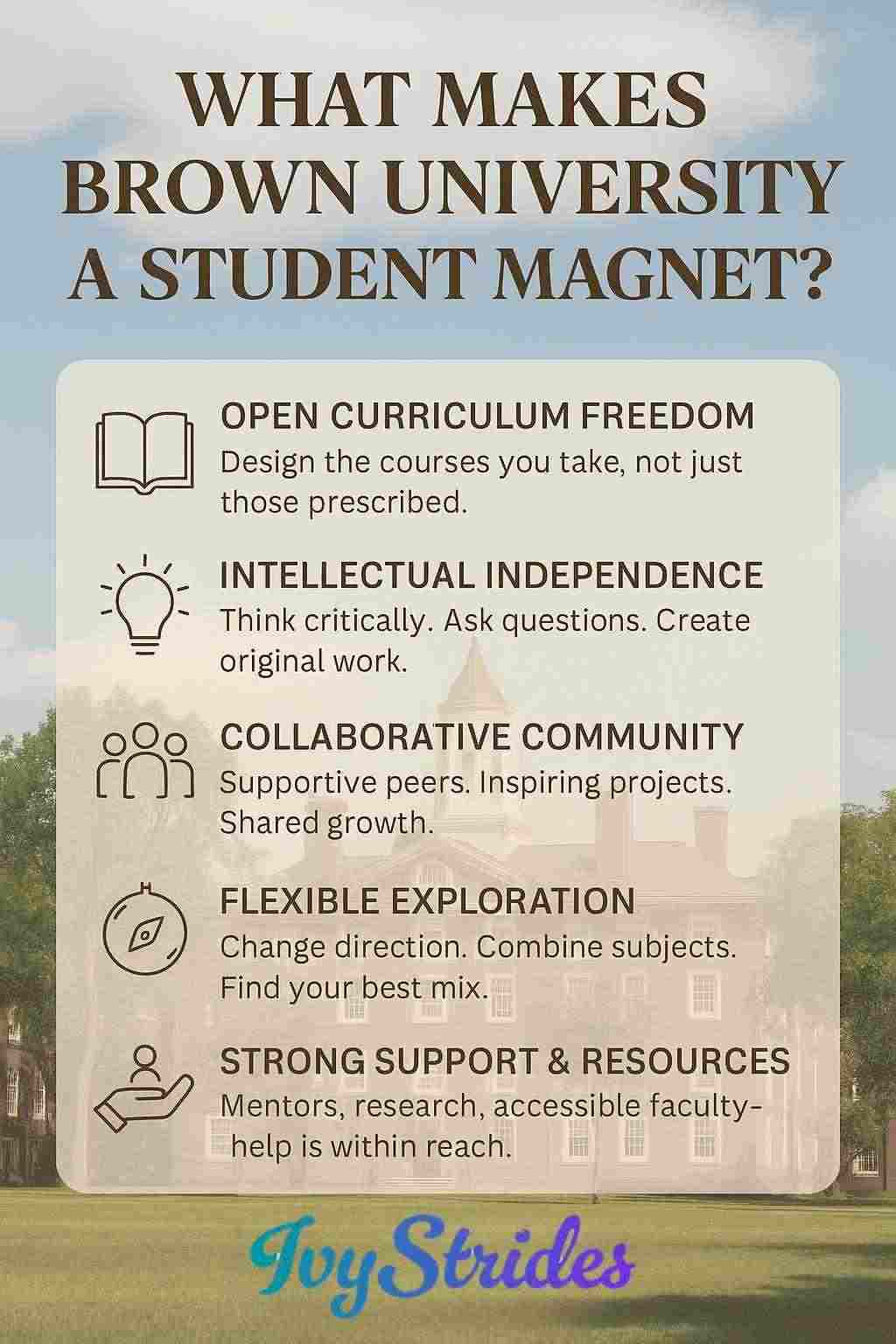
Brown isn’t just another Ivy League school with a postcard-perfect campus. It’s an academic playground where freedom isn’t just theoretical but embedded in every classroom, quad, and studio space.
The Open Curriculum: Learn What Lights You Up
Brown’s open curriculum is legendary and for good reason. No general education requirements, no core classes you didn’t choose, just pure academic autonomy.
Here, you design your own degree. Mix Applied Mathematics with Visual Art, pair Computer Science with Philosophy, or dive deep into one discipline and make it your own.
On-Campus Icons That Shape the Brown Experience
Brown’s campus isn’t just beautiful, it’s alive with intellectual purpose and artistic energy. Signature spaces include:
- The John Hay Library – Home to rare manuscripts and first editions.
- The Perry and Marty Granoff Center for the Creative Arts – A striking glass-paneled hub where multimedia projects, digital installations, and experimental art come to life.
- The Nelson Fitness Center
- The SciLi (Sciences Library)– A Brutalist icon housing breakthroughs in STEM and cognitive science, not just textbooks.
- The Brown Design Workshop– A hands-on makerspace where students 3D print, prototype, and bring ideas into form.
And it’s not just the buildings, it’s what happens inside them.
You’ll find:
- Students reading on theMain Greenunder centuries-old maples or relaxing in the Pembroke campus gardens.
- Late-night poetry slams in theRites and Reason Theatre.
- International policy debates in the Watson Institute for International and Public Affairs.
Brown’s freedom-fueled education has shaped bold thinkers, creators, and changemakers, from Emma Watson and John Krasinski to Janet Yellen and Ted Turner.
When Innovation Meets Architecture
At Brown, creativity and scholarship meet in spaces designed to inspire. From the School of Engineering’s research hubs to RISD-Brown dual degree studios, students don’t just theorize; they build, publish, perform, and prototype.
Undergraduate research symposia happen just steps away from sculpture welding or climate coding. Brown is a campus where collaboration isn’t limited to departments; it stretches across disciplines and into the real world.
If this kind of environment excites you, the freedom, the labs, the libraries, the legacy, it might be time to ask yourself:
Is Brown the Right Fit for You? Ask Yourself These 7 Questions
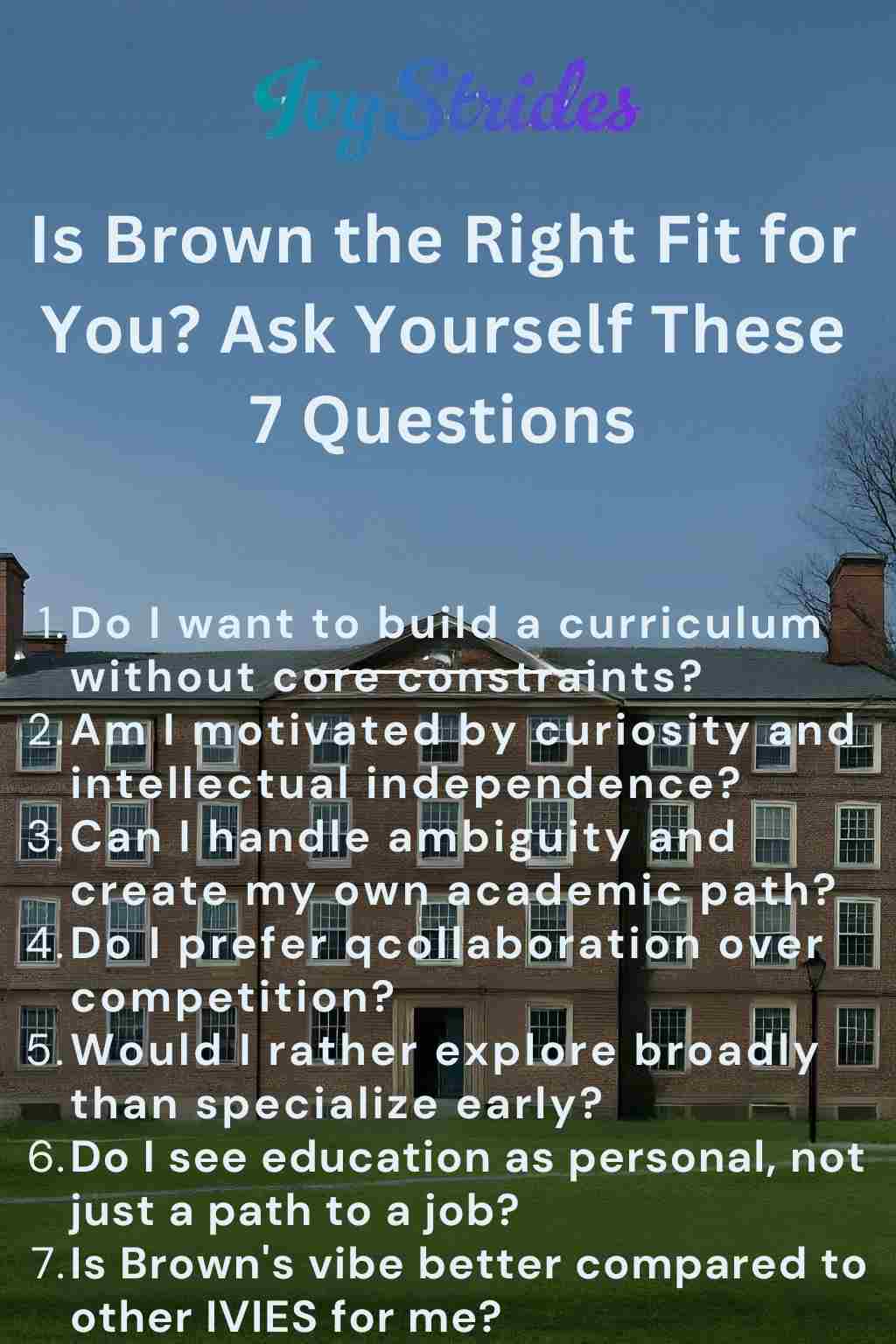
Brown University isn’t for everyone, and that’s precisely why it works. It attracts students who want more than a degree. They want direction without being told where to go. If you’re considering applying, ask yourself these seven questions to see if Brown fits you as much as you hope to fit Brown.
-
Do I want to build my own curriculum without core constraints?
→ If the idea of choosing all your classes excites you, Brown’s open curriculum is designed for you.
-
Am I motivated by curiosity and intellectual independence?
→ Brown rewards students who ask bold questions, not just follow instructions.
-
Can I handle ambiguity and carve my own academic path?
→ If you excel in self-directed environments, this is your playground.
-
Do I prefer collaboration over competition?
→ The vibe here is more “let’s build together” than “every person for themselves.”
-
Would I rather explore broadly than specialize early?
→ You can change directions without stigma — it’s part of the process.
-
Do I see education as personal, not just a path to a job?
→ Brown is where passion projects become majors, and majors evolve into movements.
-
How does Brown’s vibe compare to other Ivies for me?
→ It’s less traditional, more experimental, perfect for students who color outside the lines.
Brown Majors, Paths, and Possibilities: What Can You Study Here?
Brown doesn’t ask what you want to be. It asks who you want to become and then gives you the space to figure that out.
With over 80 concentrations (what other schools call “majors”), dozens of interdisciplinary programs, and a cross-registration partnership with Rhode Island School of Design (RISD), the academic landscape here is as limitless as your curiosity.
Top Majors That Students Love
While you won’t find a “typical” Brown student, you will see patterns of passion. Some of the most pursued concentrations include:
- Computer Science
- International Relations
- Public Health
- Neuroscience
- English and Literary Arts
Interdisciplinary Possibilities
At Brown, the most interesting degrees aren’t always found in the catalog. You can build your own. Students routinely cross into RISD to add a visual or design dimension to their Brown education. Imagine coding climate change models and animating them for public awareness, all within your undergrad years.
Want to align your SAT prep with your intended major? Use thisSAT timeline plannerto map your test dates around your academic and extracurricular goals.
Getting Into Brown University: Your Step-by-Step Strategy with IvyStrides
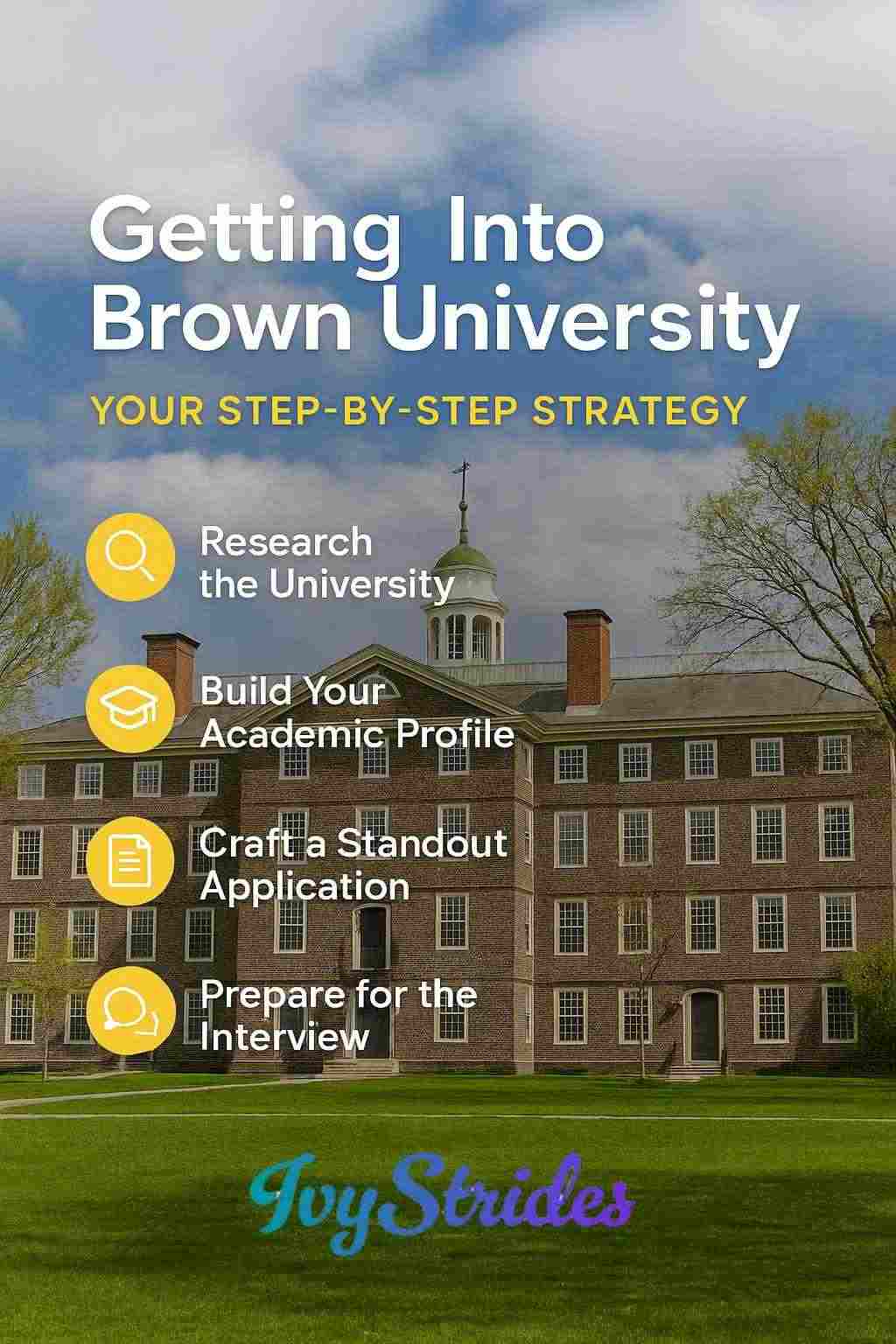
With an admit rate hovering around 5%, applying to Brown takes more than just good grades. It takes strategy, timing, and execution.
Application Platforms
You can apply to Brown through either the Common Application or the Coalition Application. Both are accepted, and there’s no preference. What matters is how well you tell your story.
Key Deadlines to Know
- Early Decision: November 1
- Regular Decision: January 3
Applying Early Decision can give you a slight edge, but only if Brown is your first choice and your application is strong by fall.
Read more about the application process here- How to apply to Brown University.
What’s in the Application?
Here’s what you’ll need to submit:
- High school transcripts showing academic rigor
- Two teacher recommendations (tip: choose teachers who understand how you think, not just how you score)
- A personal statement via the Common App
- Two Brown-specific supplemental essays
- An optional video introduction - great for showing personality
- Standardized test scores - Brown is test-optional, but strong scores help (more on that below)
- FAFSA + CSS Profile for financial aid consideration (U.S. only)
- TOEFL or IELTSfor international students, if required
Need help organizing all these parts? OurIvyStrides Application Tracker helps you keep everything on schedule.
Special Tips for International Applicants
If you're applying from outside the U.S., you’ll want to:
- Demonstrate proficiency in English
- Highlight global experiences or perspectives
- Prepare a financial aid plan. Early aid is available, but it is competitive
- Showcase your readiness to thrive in Brown’s independent learning culture
How IvyStrides Helps You Win
At IvyStrides, we’ve worked with students from New Jersey to New Delhi, helping them turn strong intentions into Ivy-level applications. Here’s what we do best:
- Personalized SAT prep based on your superscore potential
- Essay coaching for Common App + Brown supplements
- Deadline planning tools so you never miss a key date
- Strategic application guidance
Book your IvyStrides consultation and let’s map out your personalized path to Brown.
Understanding Brown’s Acceptance Rate and What It Means for You
With roughly 5 out of every 100 applicants getting in, Brown University is one of the most selective schools in the world.
But behind that intimidating number lies a more profound truth: students who understand what Brown values and how to express it rise to the top. Here’s how to make sure you’re one of them.
The Numbers, Decrypted
- Overall Acceptance Rate: 5%
- Early Decision Acceptance: 14–16%
- Regular Decision Acceptance: <4%
- Typical SAT Range: 1510–1560
- ACT Range: 34–35
- Average Unweighted GPA: 3.9+
Want to see where your SAT score stands? Check out our Brown SAT Score Scale Decoder for breakdowns and scoring tips.
Superscore Advantage: Your Secret Weapon
Here’s where strategy meets statistics: Brown superscores the SAT. That means they’ll combine your highest section scores across multiple test dates.
Example:
- SAT 1: 760 Math, 710 Reading = 1470
- SAT 2: 720 Math, 770 Reading = 1490
- Superscore = 760 Math + 770 Reading = 1530
That 60-point boost? It can make a real difference.
Explore ourSuperscore-Focused SAT Plan designed to raise your composite through targeted section retakes.
The Essays That Get You In: Writing for Brown’s Brainy Prompts
Each year, thousands of academically qualified applicants apply. But what sets the admitted ones apart? Their stories. Their weird, incredible brains. Their willingness to take intellectual risks on the page.
Brown’s Essay Philosophy: Show Us How You Think
Brown’s supplemental essays aren’t trying to trick you; they’re trying to reveal you. The prompts are crafted to see:
- What excites you intellectually
- How you process ideas
- What you’ll bring to the Brown community
- And yes - how original you can be
You’ll write:
- One Common App essay (shared with all your colleges)
- Three Brown-specific prompts, often including one open-ended question that’s so Brown (think: “What’s the best conversation you’ve ever overheard?”)
What Makes a Brown Essay Work?
Here’s what we’ve seen time and again from successful applicants we’ve coached at IvyStrides:
- They write with clarity and risk, not clichés and resume dumps
- They focus on a moment or idea, not just a list of achievements
- They’re playful, precise, and real - the kind of essay an admissions officer remembers after 40 straight reads
Need help crafting that kind of application essay?
Join IvyStrides’ Common App & Brown Essay Coaching where your ideas meet Ivy League strategy.
Is Brown Expensive? Only If You Don’t Know This
We get it, the sticker price of Brown can make your heart skip a beat. But here’s the truth: Brown is one of the most generous Ivy League schools when it comes to financial aid. If you’re a strong fit, cost should never be the reason you don’t apply.
Let’s break down what affordability really looks like at Brown.
What You See ≠ What You Pay
- Full cost of attendance: ~$80,000/year
- But most students don’t pay that
- Over 60% of undergrads receive financial aid
If your family makes under $60,000/year, you’ll likely attend tuition-free.
If your family makes under $125,000/year, significant aid is almost guaranteed.
Want to estimate your own financial aid? Brown’s Net Price Calculator gives a realistic preview.
What About International Students?
Yes, Brown offers financial aid for international applicants, too.Is it more competitive? Yes.Is it possible? Absolutely.
At IvyStrides, we help families understand forms like the FAFSA, CSS Profile, andIDOC, and create scholarship strategies that go beyond just Brown.
Schedule a free webinar with IvyStrides and learn how to make elite education affordable.
Your Brown Application Game Plan: From Sophomore Year to Senior Send-Off
If you’re in high school in the U.S., your timeline to Brown starts long before senior year. Here's how to plan your journey from sophomore year to submission day:
| Grade | What You Should Focus On |
| 10th Grade (Sophomore Year) | Lay the foundation: build strong academic habits, explore interests through clubs or community work, and start light SAT prep. Focus on reading, mental math, and time-based comprehension. |
| 11th Grade (Junior Year) | Take your first SAT/ACT by spring. Start working on your personal statement and identify 1–2 standout extracurriculars. |
| Summer Before 12th Grade | Refine your essays. Retake the SAT (aiming for a superscore), finalize your college list, and request recommendations early. |
| 12th Grade (Senior Year) | Final draft, final scores, final push. Choose between - Early Decision (Nov 1) - or Regular Decision (Jan 3). Organize your FAFSA, CSS Profile, and scholarship materials. Submit your strongest application on time. |
For International students, the academic calendar and testing windows may differ slightly, but this timeline still works with a few custom adjustments. Reach out to IvyStrides for personalized planning.
Download the IvyStrides SAT & Application Timeline PDF to keep every task, test, and deadline right in front of you.
Want to Give Your Brown Application the Edge It Deserves?
If you’ve read this far, chances are Brown already speaks to something in you: your independence, your drive, your curiosity. But great instincts need a brilliant plan.
At IvyStrides, we’ve helped hundreds of high schoolers craft standout applications, raise their SAT scores, and unlock top-tier college acceptances, including Ivy League schools like Brown.
- Does your profile fit? We’ll tell you honestly.
- Worried your SAT score isn’t enough? We’ll help raise it.
- Stuck on what to say in your essays? We’ll make your story shine.
Claim your free IvyStrides Profile Review and find out exactly how close you are and what to do next.
Join IvyStrides for expert SAT prep, personal essay coaching, and Ivy League admissions guidance.
With us, you don’t just “apply.” You apply with confidence, with strategy, and with support that works.
FAQs
Does Brown University require admission interviews?
No. Interviews aren’t required. If alumni in your area are available, you might be invited for one. Think of it as a friendly chat; it won’t make or break your application.
Can I double major at Brown?
Yes, and it’s easier here than in most places. Brown calls it a “double concentration.” Thanks to the open curriculum, students have room to explore two paths without too much red tape.
Is Brown good for STEM students, too?
Yes. Brown has top programs in Engineering, Neuroscience, Computer Science, and more. There are terrific research labs, small class sizes, and professors who really care about your growth.
What is housing like at Brown?
Most students live on campus for three years. You’ll find cozy dorms, themed program houses, and suite-style rooms. It’s a tight-knit community where people actually talk to their neighbors.
Are there programs for first-gen students?
Yes. Brown supports first-generation students through the FLi Center, peer mentors, and custom advising.
Is the Brown-RISD Dual Degree Program hard to get into?
Yes, it's highly selective. Fewer than 20 students are admitted each year. You’ll need to apply to both schools and write an extra essay. But if you’re both artistic and academic, it’s worth it.

Hemant is a seasoned entrepreneur, investor, and growth strategist with deep ground in education and technology-driven learning. His core training is in Mathematics and Physics — he authored Physics for IB Diploma: Ultimate Revision Guide, recognized as a top student resource.