
Should You Apply to Cornell University in 2026? A Strategic Breakdown of Acceptance Rates, Admission Criteria & Applicant Fit
On this page
- Thinking About Cornell University? Here's What This Ivy League School Is (Really) Like
- What Does Cornell Really Look for in Applicants?
- SAT or Not? Test-Optional Strategy & Superscoring Explained
- Step-by-Step: How to Apply to Cornell University (US & International Applicants)
- For All Applicants:
- Important Deadlines to Remember:
- Writing Essays for Cornell? Here's How to Craft One That Gets You Noticed
- Is Cornell University Affordable? How Much Does It Cost to Attend?
- Cost Estimate for 2026–2027:
- When Should You Start Your Cornell Prep? Timeline by Grade
- Grade 9: Foundation Year
- Grade 10: Sophomore Year
- Grade 11: Junior Year
- Summer Before Grade 12: Senior year
- Grade 12: Final Prep & Application
- Still Unsure? Take This Quick Quiz to See if Cornell Fits You
- What If Cornell Isn’t Your Final Destination? Great Alternatives to Consider
- If you like Cornell’s balance of tradition + innovation:
- If you’re aiming for Ivy League or Ivy-adjacent prestige:
- Student Voices & Final Thoughts: Is Cornell the Right Choice for You?
- Ready to Take the First Step?
- FAQs
Every year, someone walks into our virtual office, stares into the camera, and asks with half a grin and full-on nerves:
“Be honest - should I even try for Cornell?”
It’s a fair question. Cornell University is a heavyweight in the Ivy League. The kind that pairs a Nobel Prize pedigree with brutal winters, sprawling libraries, and a lecture hall that might change how you think about, well, everything. For some, it’s magnetic. For others, it’s mismatched energy in an elite disguise.
At IvyStrides, we’ve helped students crack that code, not just on getting in, but on knowing if they even should.
This blog isn’t here to sell you a dream. It’s here to hand you the blueprint: how Cornell admits, who fits, what matters (and what really doesn’t), and whether you should pin your 2026 application hopes to this institution on a hill.
If you’ve got questions, you’re in the right place.
Schedule a one-on-one consultation with our counsellors today!
Thinking About Cornell University? Here's What This Ivy League School Is (Really) Like
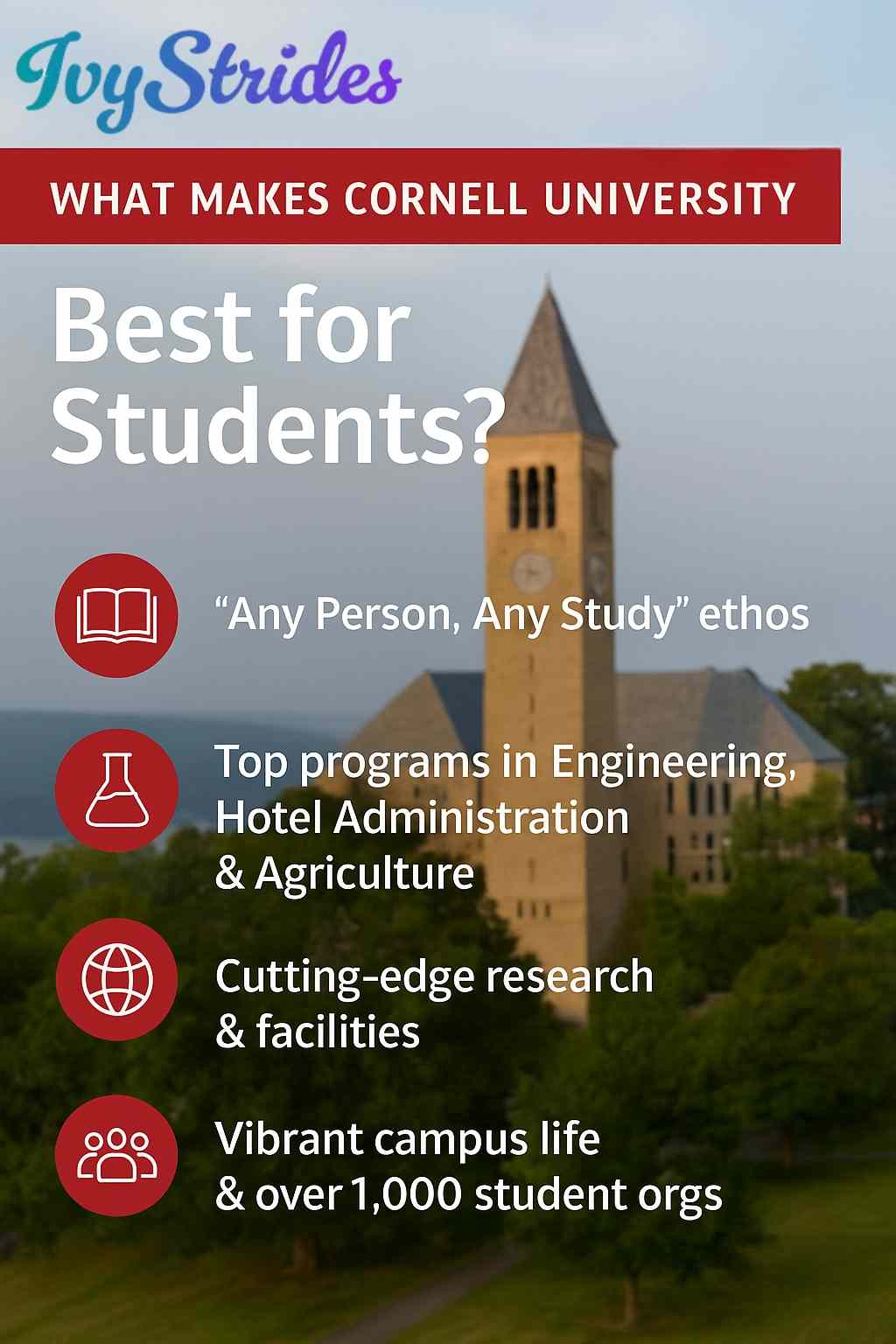
Perched on the hills of Ithaca, New York, the Cornell University campus stretches across waterfalls, wooded trails, and Gothic buildings that feel straight out of a movie. One moment you’re walking across the iconic Arts Quad, the next you’re grabbing bubble tea on Collegetown’s Eddy Street, or studying under vaulted ceilings at Uris Library, with a view that somehow makes cramming feel poetic.
Academically? It’s unmatched in range. You’ve got seven undergraduate colleges, each with its own identity, from the world-famous School of Hotel Administration, to the innovativeCollege of Engineering, to the College of Arts & Sciences, which lets you build your own intellectual playground. And don’t miss theILR School if you're into business, law, or public policy.
Cornell is for the builder, the thinker, the wanderer who’s not here to follow, but to figure things out their way. If that sounds like you, you're already closer than you think.
What Does Cornell Really Look for in Applicants?
When it comes to admissions, Cornell is reading for alignment.
It starts with how well you fit into the college within the university. Each undergraduate school at Cornell has its own lens, its own values, and often, its own application requirements. That’s where many applicants misstep; they write one broad application and hope it lands.
At IvyStrides, we’ve worked with students who applied to everything from the College of Arts & Sciences to Architecture, and the common thread among successful applicants is this: they knew why they belonged in that specific program, and they made it clear.
Academic rigor is a given; most admit have GPAs above 3.8 and strong AP or IB coursework. But what sets students apart is the sense of purpose. Whether it's a research paper, community initiative, or design portfolio, your application should tell one focused, intentional story.
Especially for international applicants, showing why Cornell matters to you makes all the difference.
Attend a free webinar with our experts in college admissions.
SAT or Not? Test-Optional Strategy & Superscoring Explained
Cornell remains test-optional through 2026, but “optional” doesn’t mean irrelevant.
Here’s what we’ve seen firsthand at IvyStrides: strong SAT scores still help, especially if your high school doesn’t offer APs or you’re coming from an international curriculum. Admissions officers are looking for ways to benchmark you against a global pool, and the SAT gives them one.
If your score lands in the 1470–1570 range, it’s worth submitting. That’s the middle 50% for most accepted students. If your score falls below that, we help students weigh other strengths like GPA, essays, and academic rigor, before making the call.
Cornell also superscores, meaning they’ll consider your highest section scores across multiple test dates. If you scored a 740 in Math in June and a 760 in Reading in October, they’ll combine those into a 1500, and not average them.
If you're applying internationally, remember: Cornell does require proof of English proficiency. You can meet this through the TOEFL, IELTS, or Duolingo English Test, depending on your background.
If you're considering sending scores, a little focused prep can go a long way.
Make your SAT score count, join IvyStrides SAT prep classes today, and aim for the 1500+ edge.
Step-by-Step: How to Apply to Cornell University (US & International Applicants)
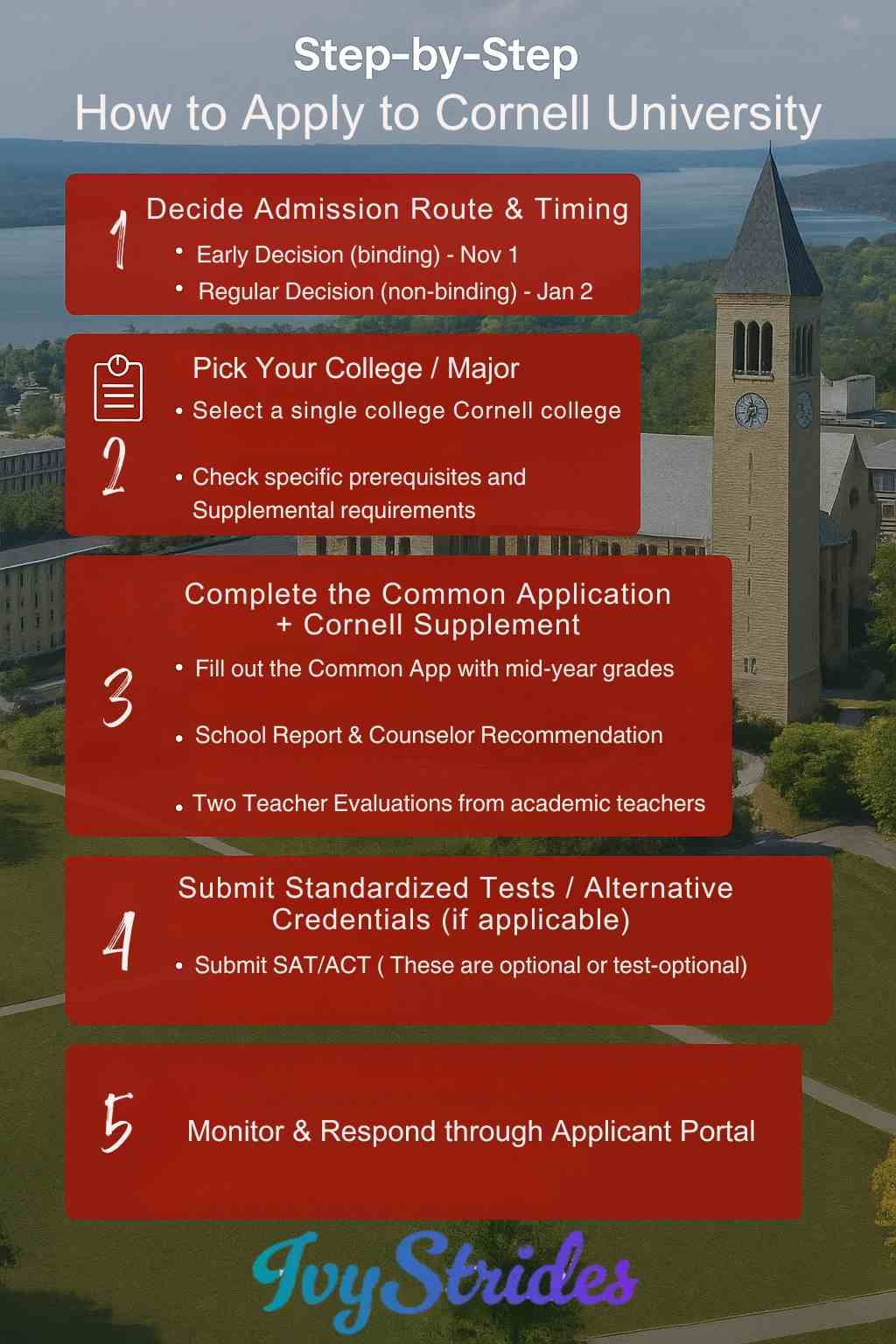
The Cornell application isn’t complex, but it is layered. And the process looks a little different depending on which undergraduate college you're applying to, and whether you're applying from Texas, Toronto, Hyderabad, or somewhere in between.
At IvyStrides, here’s how we guide students through it:
For All Applicants:
- Choose Your Undergraduate College
Cornell has seven: Arts & Sciences, Engineering, Business (Dyson), Architecture, ILR, CALS, and Hotel Administration. Each has its own prompts and priorities.
- Apply via the Common App
Cornell only accepts the Common Application. You’ll select your college, submit your essays, recommendations, and fee.
- Submit Your High School Transcript
Your GPA, course rigor, and class rank (if available) matter more than just your letter grades.
- Send Test Scores (Optional)
SAT/ACT optional for 2026, but TOEFL/IELTS/Duolingo required for most international applicants.
- Two Teacher Recommendations
Choose teachers who can speak to your thinking style, not just your grades.
- Complete the Cornell Supplement
Each college has a tailored short-answer essay, which is where most students rise or fall.
- Optional: Submit an Art/Design Portfolio or Additional Materials
Required for some majors like architecture and fine arts.
- Apply for Financial Aid (If Needed)
U.S. students submit the FAFSA + CSS Profile. International students submit the CSS Profile + documentation if applying for aid.
Important Deadlines to Remember:
- Early Decision: November 1 (approximately)
- Regular Decision: January 2 (approximately)
- TOEFL/SAT/portfolio documents should be received shortly after these dates.
At IvyStrides, we help students organize, optimize, and get their applications done on time (without the panic).
Writing Essays for Cornell? Here's How to Craft One That Gets You Noticed
Every undergraduate college at Cornell has its own supplemental essay, and that one response often carries more weight than students expect. There’s no Common App-style “pick your favorite quote” prompt. Cornell wants to know why you’ve chosen that specific college, and how it connects to your academic path.
For example:
- Applying to the College of Engineering? Talk about a design challenge you couldn’t stop thinking about and what you learned.
- Applying to ILR? Focus on your interest in law, policy, or labor relations, and how real-world exposure shaped it.
- Choosing Arts & Sciences? Go beyond “I love learning” and point to an actual curiosity you’ve explored deeply.
At IvyStrides, we help students map their academic and personal stories to the mission of each Cornell college. The goal is to make your essay feel inevitable, like you and that program were meant to meet.
How do you make your story stand out? Our essay coaching helps you turn ideas into impact, one draft at a time.
Is Cornell University Affordable? How Much Does It Cost to Attend?
Applying to Cornell is a financial decision in addition to an intellectual one, so let's talk about the figures.
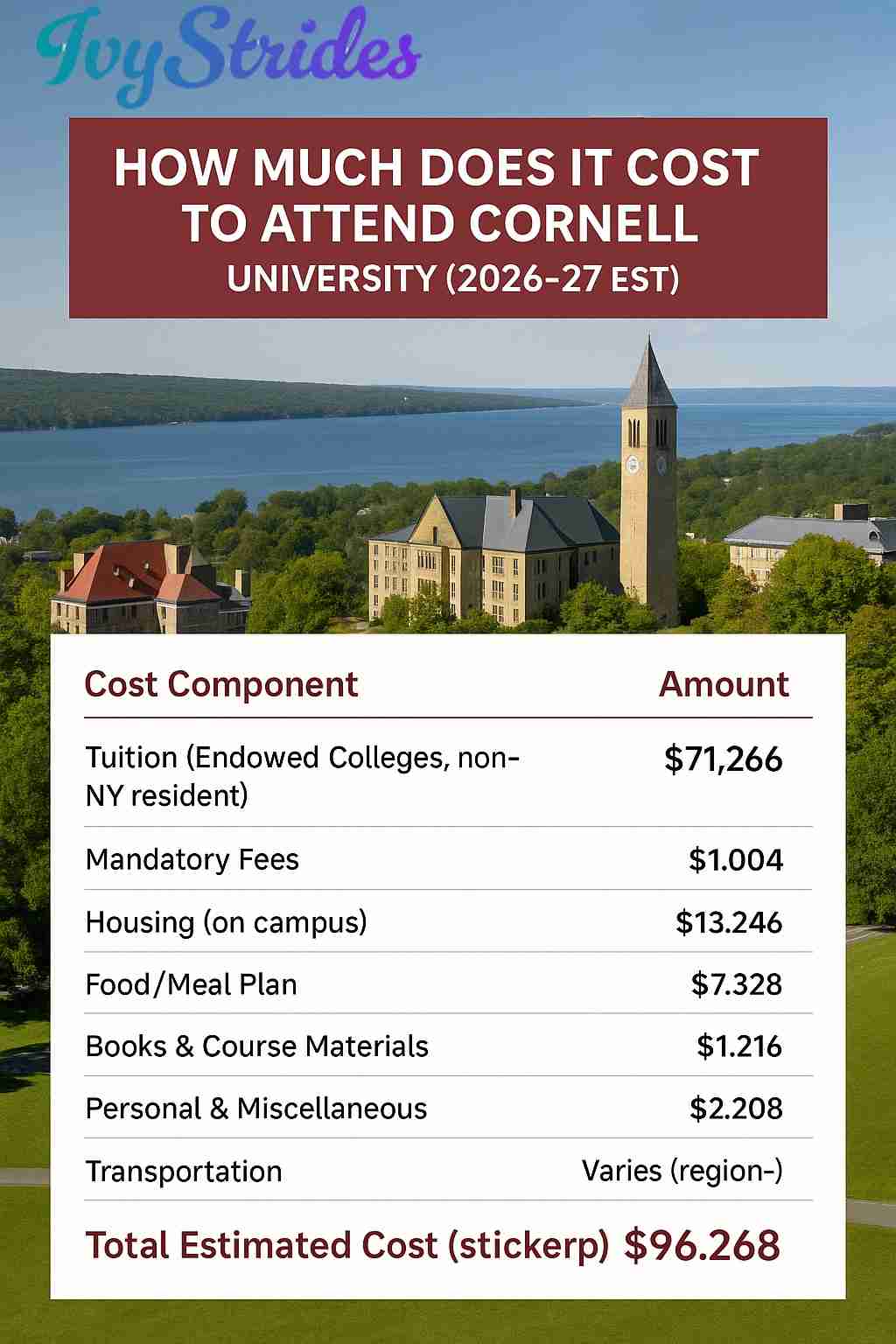
Cost Estimate for 2026–2027:
- $71,266 for tuition
- Required Fees: $1,004
- Accommodations: $13,246
- Plan for Meals: $7,328
- Course Materials & Books: $1,216
- $2,208 for personal expenses
Total estimated: $96,268 annually
Although these are the official figures, some students may actually incur larger expenses. For instance, Cornell requires membership in its Student Health Insurance Plan (SHP), which can cost an additional $3,700 annually if a qualifying health plan does not currently cover you. The sum may also be increased by optional course fees and travel expenses, particularly for overseas students.
Can You Afford It?
For U.S. students, Cornell is need-blind and meets 100% of demonstrated need. That means if your family qualifies for aid, Cornell will cover the gap with grants. Students from households earning under $60,000 often pay little or nothing.
For international students, Cornell is need-aware but still offers aid through the CSS Profile and institutional grants. It’s competitive, but very possible if your application is strong and your need is well-documented.
At IvyStrides, we help families calculate real costs, build aid strategies, and apply for external scholarships that reduce the burden, especially for Indian students applying from CBSE, ICSE, and IB boards.
When Should You Start Your Cornell Prep? Timeline by Grade
Getting into Cornell doesn’t happen overnight, and it’s not just about checking boxes. It’s about building direction, depth, and story over time. Here’s when (and how) we suggest students start preparing.
Grade 9: Foundation Year
- Focus on academic consistency; a high GPA matters later.
- Explore subjects that spark curiosity, especially STEM, humanities, or social sciences.
- Try something new: clubs, a small project, or community work.
Grade 10: Sophomore Year
- Start informal SAT prep: reading stamina, mental math, and grammar drills.
- Take our SAT practice tests to identify your strengths and sharpen your strategy.
- Take on leadership roles in 1–2 activities. Don’t chase quantity.
- Build a résumé of early impact, not just participation.
Grade 11: Junior Year
- Take your first official SAT by spring.
- Dive into subjects or projects aligned with your intended Cornell college (e.g., research, writing portfolio, internships).
- Begin shortlisting recommenders and prepping for essays.
Summer Before Grade 12: Senior year
- Retake SAT (Cornell superscores make it count).
- Begin Cornell-specific essays with college alignment in mind.
- Refine your application story: what makes you you?
Grade 12: Final Prep & Application
- ED Deadline: Nov 1 | RD Deadline: Jan 2
- Finalize all materials: essays, supplements, and aid forms.
- Submit your best superscore if applicable.
- Don’t forget your TOEFL/Duolingo score if required.
It’s not about doing everything, it’s about doing your thing well, early, and with intention. That’s what IvyStrides helps students discover.
Still Unsure? Take This Quick Quiz to See if Cornell Fits You
Not everyone qualified is necessarily a fit, and that’s okay. At IvyStrides, we’ve learned that applying to Cornell is as much about resonance as it is about stats.
Take this quick self-check. If you nod “yes” to most of these, Cornell might be your kind of place.
Consider this:
- Do I like learning for its own sake, independent of grades?
- Do I want to feel recognized even though I'm drawn to a large campus setting?
- Do I already have a Cornell major or college in mind?
- Would I flourish in an environment that encourages multidisciplinary thinking?
- Do I want early access to both practical research and Ivy League rigor?
- Can I explain how Cornell College aligns with my objectives?
- Am I prepared for Ithaca's lengthy winters?
Although it isn't scientific, this quiz captures the essence of what makes Cornell special.
What If Cornell Isn’t Your Final Destination? Great Alternatives to Consider
Not every student who applies to Cornell ends up there, and not every student should. But that doesn’t mean your ambitions end.
What we’ve seen again and again at IvyStrides is that students who prepare for Cornell-level schools often end up with multiple high-impact offers. That’s the beauty of aiming high: it opens doors.
Here are a few excellent alternatives with similar academic rigor, values, or programs:
If you like Cornell’s balance of tradition + innovation:
- University of Michigan – Ann Arbor
- University of North Carolina at Chapel Hill
- University of Virginia
If you’re aiming for Ivy League or Ivy-adjacent prestige:
- Dartmouth College
- Brown University
- Northwestern
- Duke
No matter where you land, the right school will be the one where your story feels possible and your ambition feels supported.
Student Voices & Final Thoughts: Is Cornell the Right Choice for You?
We’ve walked alongside students who got into Cornell and those who didn’t, but still landed somewhere just as extraordinary. And when we ask what made the difference, it’s rarely just a test score.
It’s confidence. Clarity. Strategy.
One of our students from Texas, who’s now thriving in Cornell’s Dyson School, once said:
“It wasn’t just about getting in; it was about feeling like I earned the right to belong. IvyStrides helped me get there.”
So, is Cornell right for you? If you’re curious, driven, and ready to stretch yourself, maybe it is. And even if it isn’t, aiming for a place like Cornell helps shape a stronger version of you, no matter where you go.
Ready to Take the First Step?
Join our SAT Fall Batch, explicitly designed for high-achieving students with Ivy League goals. We’ll help you go beyond guesswork and build the kind of application that reflects your real potential.
FAQs
What GPA do you need to get into Cornell?
Most students who get into Cornell have a GPA close to 3.8 or higher. But don’t panic if yours is lower. What matters just as much is how challenging your classes were and whether your grades show an upward trend. Cornell looks at the whole picture, not just the number.
Does Cornell offer interviews for undergrad admissions?
Nope - Cornell doesn’t do interviews for most students. You won’t need to talk to an alum or admissions officer. But if you're applying to programs like Architecture or Art, you might need to submit a portfolio. That’s how they get to know you beyond your application.
Can I apply to more than one college at Cornell?
You have to pick one college or school within Cornell when you apply, like Arts & Sciences, Engineering, or ILR. Each one has different programs and vibes, so choose the one that fits your goals best. You’ll also write an essay just for that college.
Does Cornell care if I visit or show interest?
Not really. Cornell says it doesn’t track “demonstrated interest.” So things like campus visits or signing up for emails won’t affect your chances. But writing a brilliant, thoughtful “Why Cornell” essay? That shows genuine interest, and that does help.
What if I get waitlisted?
Getting waitlisted means Cornell liked you, but just didn’t have enough space yet. You can say you’d still like to attend and send a quick update with any new wins or grades. Cornell does accept some students off the waitlist, usually in late spring.

Hemant is a seasoned entrepreneur, investor, and growth strategist with deep ground in education and technology-driven learning. His core training is in Mathematics and Physics — he authored Physics for IB Diploma: Ultimate Revision Guide, recognized as a top student resource.